
Chapter 9: The Firebird Factory
Ten games in twelve months, Bertie Big Boy, and the Forbidden Amigas.

The transition from a boutique studio to an industrial assembly line didn’t happen with a bang. It happened with a signature.
Paul McKenna, our Managing Director, had pulled off a significant coup. He had convinced British Telecom, specifically its software arm, Telecomsoft, and, more specifically, its “Firebird” label, to hand over a six-figure sum. In 1986, in a city like Liverpool, a six-figure contract was life-changing money. It was enough to run the company, pay the salaries, and keep the lights on in Canning Place for a year.
But the money came with conditions. The contract stipulated that Odin Computer Graphics would deliver ten games within twelve months. And we’d be paid in milestone deliverables as the titles were delivered.
Ten games. One year.
It was a lucrative deal, but it was aggressive. In the previous year, we had poured our hearts and most of our waking hours into just two major titles, Nodes of Yesod and Robin of the Wood. Now, the math had changed. We were expected to quintuple our output without quintupling our staff. The deal introduced a “points” system. A full, original game counted as one point. A port to another system, like the Amstrad or C64, counted as half a point.
Whatever artistic pretensions we had were immediately subordinate to the bean-counting. We weren’t just making games anymore. We were filling a quota, eking out points on a system.
My first assignment on this new assembly line was Heartland. This was “Notch Number One” for Firebird. I teamed up with Colin Grunes, the artist who had animated Astro Charlie in Nodes. Colin was a quiet talent, someone who understood that on a machine like the Spectrum, what you didn’t draw was just as important as what you did.


The Heartland design was dictated by the schedule. We didn’t have time for complex physics or elaborate systems, so it became a maze game with simple mechanics and a side-view perspective. That didn’t mean it was small. The map was extensive, spread across five distinct worlds. The brief was essentially to get it done. Even so, I didn’t want it to feel cheap. I wanted it to be a vehicle for Colin’s art, and for some new coding ideas I’d been itching to try.
At the center of it all was a wizard named Eldritch, though everyone called him Bertie, his full name possibly being Bertie Big Boy. Both his name and the game’s were deliberate nods to the Sisters of Mercy: their frontman is Andrew Eldritch, and “Heartland” is one of their songs. The original working title for the game was actually Kimera. We dropped this once we realized Firebird already had a Chimera on their books.
There were several ways to draw graphics on the Spectrum, but most produced flicker or odd artifacts when objects overlapped. Without hardware sprites, characters were typically drawn by inverting or blending with the background, creating the familiar jittery transparency in which the scenery showed through the character. I wanted Heartland to feel solid. I wanted the characters to glide over the background like cut-outs sliding across a table. To achieve this, every object needed a “mask,” a silhouette that punched a black hole in the background before the colored pixels of the sprite were dropped in.
The masking had been born while Robin of the Wood was still finishing, when Colin drew Bertie’s walk cycle and I started running it through my early mask code just to see what would happen. Before long I had a screen full of Berties pacing left and right, and that was the moment the whole look of the game fell into place.
The problem, as always, was memory. We wanted to avoid the dreaded “multiload,” where the player has to stop and load the next level from tape, which meant all the graphics for all five levels had to sit in RAM simultaneously. Storing a pre-drawn mask for every single frame of animation for the hero, the enemies, and the projectiles was mathematically impossible. The masks would have taken up more space than the game itself.
“It won’t fit, Steve,” Colin told me, totting up the estimated number of sprites and background elements, and their masks. Including a mask effectively doubled the storage needs.
“Then we don’t store the masks,” I said. “We generate them.”
I decided to write a routine that would build the masks in real time, on the fly, as the level initialized. It was a heavy lift for the Z80, but it saved us kilobytes of storage. The process was essentially a bit-shifting blurry photograph. I would take the original graphic, copy it to a buffer, and then “smear” it. I shifted the image left by one pixel and logically OR’d it with the original. Then I shifted it right and OR’d it again. Then up. Then down. Finally, I would bitwise invert the whole blob to create the perfect negative hole.
When we finally saw Bertie walking across the screen, the effect was subtle but distinct. He didn’t flicker. He didn’t invert. He glided. The combination of Colin’s careful pixel work and the dynamic masking gave the game a solidity that most Spectrum titles lacked. It was a “quality” feel, even if the game itself was relatively simple.
We also reused the “dirty rectangle” system from Robin of the Wood. Instead of redrawing the whole screen every frame, which was too slow, or just the sprites, which left trails, we kept track of exactly which rectangular areas of the screen had changed. We only redrew those bits. The combination of the heavy masking calculations and the dirty rectangle management hit the frame rate hard, but since Heartland was a puzzle game rather than a twitch shooter, we got away with it.
I don’t mean to make light of the effort we put into Heartland; it was another grind, and I did manage to complete the development of the Spectrum version without help this time.
It was a good game. It was a solid start to the contract, and the press agreed. Crash made Heartland a Smash in issue 31, with 92% overall, 93% for the graphics, and another 93% for addictive qualities. Sinclair User stamped it a Classic and called it “stunning to look at, delightful to play.” What the reviewers kept circling back to was the very thing Colin and I had agonized over, the solid, glide-not-flicker feel that the dynamic masking bought us. The trick nobody could see in a screenshot turned out to be the thing they felt with a joystick in their hand.
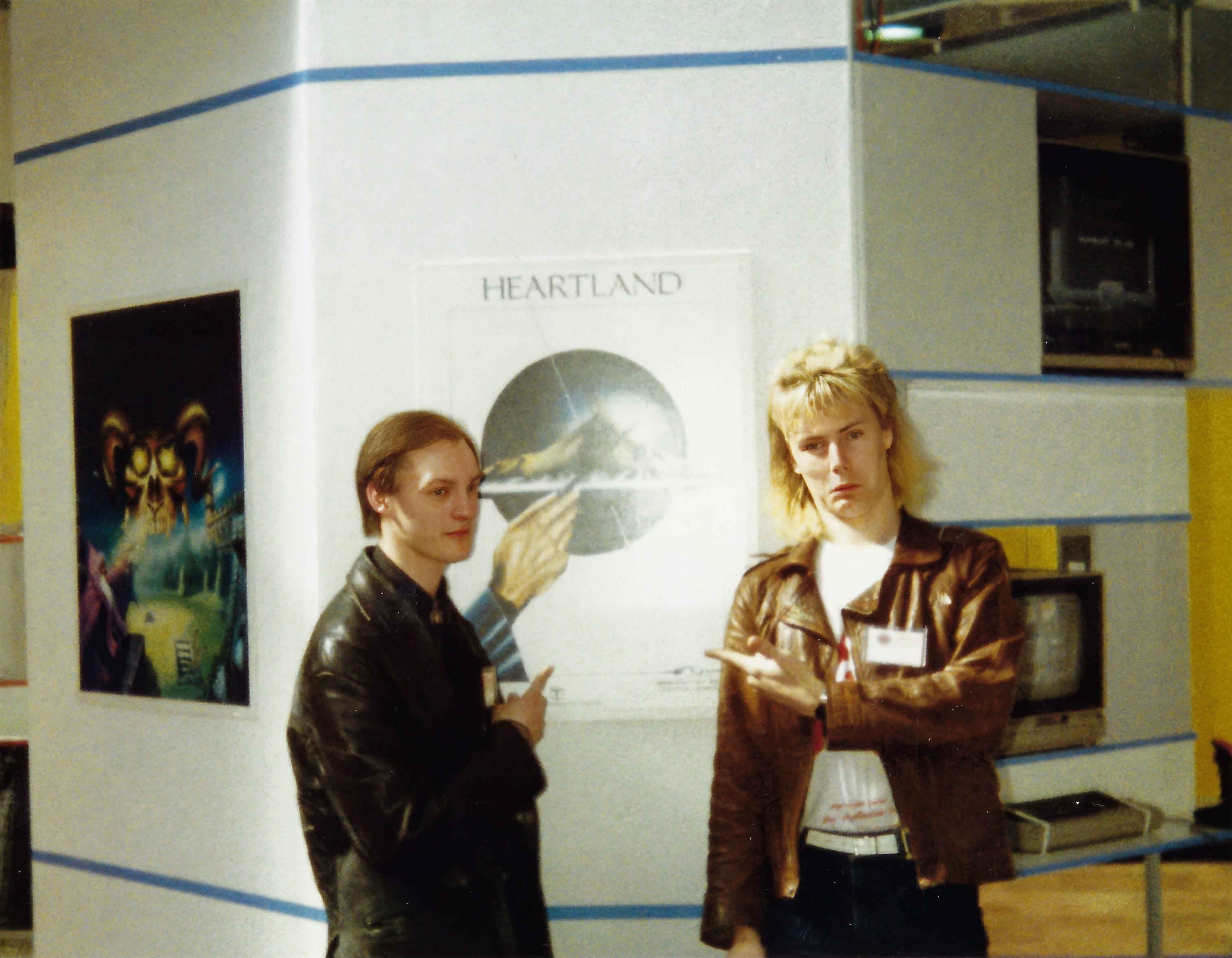
Under the points system, Heartland could not remain a Spectrum exclusive. It had to fan out across the other machines. Keith Robinson, who had stepped in late on Robin of the Wood to help get the Spectrum version over the line, took the Commodore 64 conversion. He picked it up once the Spectrum game was well underway, and my part was mostly to hand over the data structures and the way the graphics were organized, then answer questions when the code threw up surprises. A version for the Amstrad would come later, but that is a story for another chapter. Keith Tinman wrote the music, a two-voice beeper piece built on the player Andy Walker and I had evolved out of Robin of the Wood.
The contract reshaped us physically, too. Building ten games in a year meant hiring, and hiring meant desks. In fact, midway through Heartland, we had moved just across the Canning Place podium from Steers House to a far bigger spread of space in Mulberry House: several sections of office, a conference room, and an attached warehouse. And it was not just any space. We had taken over the very offices Bug-Byte itself had occupied, where they had first published Manic Miner, the game whose Amstrad port had eaten months of my life at Software Projects, the studio Matthew Smith founded after walking that very code out of these doors. Bug-Byte had gone under the year before, which was how the space came free.
We already knew the building. Spool, a cassette duplication firm that Bug-Byte partially owned until the publisher went under, operated several floors above. It was run day to day, I believe, by a man named Pete Mossop. In the early Nodes and Robin days, Odin had used it to manufacture our tapes, and on numerous occasions, I had trotted across the podium, ridden the elevator up, and fed a master cassette into the duplicating machines. Then came the part I dreaded: running off a copy and loading it back to check it. Most of the time, it was fine, but there was always a knot in my stomach while it loaded, and at least once, the copy refused to load at all, sending me on a frantic dash back to the office to find the fault so we could hit our always-tight distribution deadline.
One of those trips up to Spool I remember more sharply than the rest, and not with any fondness. While I was finishing Arc of Yesod, I had tucked a scrolling message into the game, a soppy little tribute to my then paramour. It was meant as a private joke, the sort of thing you assume no one will ever find. It went onto the master, through the duplicator, and out to the distributors. Inevitably, Paul McKenna found it and hit the roof. He wanted it gone immediately, which meant remastering the game and duplicating it all over again. That was a real walk of shame: not trotting eagerly this time but trudging, freshly bollocked, up the Mulberry House elevator, to stand in front of Pete and explain myself while he patiently took me through the steps to put it right. I am fairly sure a few of the forbidden copies had already slipped out into the wild by then. Somewhere out there, a cassette of Arc may still be quietly carrying her name. It was a red-faced education in the difference between a private joke and a published one.
By the time we moved into Mulberry House below it, Spool had gone quiet for us. Firebird now ran its own duplication, and the duplication machines I used to dread were sitting several floors up, no longer any of our concern.
A reader might reasonably wonder where I was actually living, given that the last anyone saw of my domestic arrangements, my landlords had changed the locks, and I had loaded my life into a Transit van.
The honest answer, for a while, was nowhere in particular. I spent a stretch on the Odin office floor, and another on the floor of Paul McKenna’s living room. Paul did more than tolerate me. It was partly his encouragement that led to what came next, which was one of the more improbable property deals of the decade.
Marc, Stoo, and I hatched a plan a sensible person would have run from. I was the one who looked most respectable on paper, my visits to the Birkenhead police station notwithstanding, though that was not saying a lot. It simply meant I had the least threadbare credit history of the group. So the scheme was this. I would apply for a mortgage. Me, at the ripe old age of twenty-two. Not for a flat, but for a three-bedroom semi-detached house in Croxteth Park, courtesy of the Bradford and Bingley Building Society.
Why would a single twenty-two-year-old need three bedrooms? That was the Faustian part. Marc and Stoo would move in and pay me rent, amounting to about two-thirds of the monthly payment. I would carry the loan, a twenty-five-year endowment mortgage in my name and my name only, and they would cover the bulk of it. A win-win, we told ourselves, and signed.
And so I became, on paper, a homeowner at age twenty-two. The canny reader may already spot the flaw in an arrangement where one man holds all of the liability and the other two hold all of the freedom to walk away, but that reckoning was years off. For now, the three amigos had a house in Croxteth Park, and I had a mortgage I would not properly understand for a long time to come.
One night, with no warning, Paul McKenna showed up at the house. Marc was there, Stoo, myself. Paul did not make small talk. “Guys, we have to do something to get all these games under control. We’re running up to ten at once, more if you count the ones that only earn half a point against the target. We need some management in place.” That gave Marc and me pause. We’d watched the company try to add management layers before, with Mark Butler and Gary Bracey each doing short stints in “manager” roles, and neither had taken. But Paul had something else in mind. “Marc, you’ll be the C64 development manager. Steve, you’ll be the Z80 development manager. Between you, you’ll run all the 8-bit work for the Firebird deal.” Excitedly, naively, with no experience and no real idea what the word “manager” entailed, we both said yes. There may have been a pay rise. I don’t remember.
The new title changed nothing about the old job. We kept coding full-time and took the management on top of it. Some of the staff didn’t care for the arrangement, and I caught pushback from a few quarters that was sharper than the situation seemed to warrant. The clearest example came when I called a casual all-hands in the lunch room to talk through vacation policy, and mentioned, mildly, I thought, that we’d need notice for absences going forward. Something in the delivery, or the substance, landed wrong with one person, who stood up in front of everyone and bawled, “You can’t do that!” I was taken aback. It had seemed like a reasonable ask. And so now I was second-guessing myself. Wait, can I ask for notice? Not all fun and games, this “boss” thing.
But the grind of the “ten games” mandate was beginning to alter the office chemistry. The atmosphere at Odin had always been a mix of intense technical focus and student-union hedonism. We were young, we were making money, and we were in Liverpool in the mid-80s. But as the pressure mounted, the behavior occasionally frayed at the edges.
One afternoon, a sign mysteriously appeared in the front window of the Odin office, facing out toward the busy street near the Albert Dock. It read, in bold, professional lettering:
FIT BIRDS APPLY WITHIN.
For the uninitiated, “fit bird” is a particularly Northern, particularly 1980s colloquialism for an attractive woman. It was juvenile, it was unprofessional, and looking back, it was “of its time.” Paul McKenna, ever the hustle-first businessman, was usually sharp about the company image, but he missed this addition to the decor for quite a while. We watched from our desks, suppressing giggles, as people stopped on the sidewalk, frowned at the sign, checked the building number, and walked on.
The unlikely outcome of this prank was that someone actually called us out on it. A young woman walked in, very clearly aware of what the sign said, and asked what it was about. She didn’t get a job, but she did get a husband. She ended up marrying one of the programmers. In the chaotic ecosystem of Odin, even a stupid joke could lead to matrimony.


We also tried to maintain the illusion of being a serious “media company” capable of handling major licenses. Paul had become aware of a new animated film called When the Wind Blows. It was written by Raymond Briggs, best known for The Snowman, which had already been turned into a successful game.
“This is the next big thing,” Paul announced. “We’re going to get the license. We’ll build it on the Heartland engine.”
He organized a company outing. We all trooped down to the local ABC Cinema in Liverpool to watch the film. We sat there in the dark, a row of twenty-something coders and artists, expecting a heartwarming tale about a snowman coming to life or a Father Christmas adventure. Instead, we watched a harrowing, devastating story about an elderly couple slowly dying of radiation sickness in the aftermath of a nuclear war.
We walked out of the cinema in stunned silence. The cognitive dissonance was deafening. The idea of turning that story into a platform game where you jump over obstacles was obscene. Even Paul, with his relentless commercial optimism, seemed shaken. We did go through the motions of presenting a design document, mostly because we had to show willing, but I was deeply relieved when Mr. Briggs’ camp decided they didn’t want a video game based on his story.
We dodged a bullet there. But there were plenty of other bullets coming. Firebird wanted their games.
By then, Odin had a surprising number of titles in motion at once. Some were full original games; others were half-point ports spread across the ZX Spectrum, Commodore 64, and Amstrad CPC. Heartland alone existed in multiple versions, while Nodes of Yesod and Hypaball were counted again as they moved to new machines. Alongside those were one-off originals like U.F.O., Scary Monsters, On the Tiles, Mission A.D., and The Plot, most of them aimed at the Commodore 64, plus a growing tail of Spectrum and CPC projects such as Tank Game, Spartacus, and P.L.O.D. Some shipped on cassette, some on disk, some on both. Others stalled or quietly disappeared.
On paper, it all reduced neatly to points. In the office, it felt like standing in the middle of a production line that never stopped moving.
Of the ten games, I would end up delivering two and a half myself: the Spectrum Heartland, the Amstrad version that came later, and Sidewize, still down the road. But working at that pace exposed something we were reluctant to admit. Odin simply did not have the management experience to run ten projects at once. Bolting the word “manager” onto Marc and me hadn’t conjured any. What had worked beautifully when one or two games were in flight, a handful of us improvising as we went, did not scale to ten, and the quality of the work suffered as a result. We were learning, the expensive way, that volume and craft tend to pull in opposite directions when the calendar is the only thing in charge.
Still, amongst all the floundering, some things made sense. I liked the technical conversations with the other engineers, and I was good at them. And I found I could take what was happening down in the code and put it in plain terms for the artists and designers, who had no reason to speak Z80. I didn’t know it, but these things would be a good part of what I’d be doing over the next forty-something years.
If the Spectrum era was a factory, the Amiga era was a glimpse of a future we were not allowed to have. It arrived in the back of a Range Rover.
Sometime in 1986, Paul McKenna drove Marc and me down to Leicester on a dark, rainy Tuesday evening. Paul had used his connections to secure some of the very first Commodore Amiga 1000s in Europe: one each for Marc and me, and at least one for the artists’ room: probably four or five in total. We loaded the boxes into the Range Rover with a reverence usually reserved for religious artifacts. We drove back to Liverpool in a state of high agitation and set them up immediately. To understand the shock of the Amiga, you have to remember what we were used to. The Spectrum was a machine of jagged edges, color clashes, and beeps. The Amiga was a spaceship. It had 256KB of RAM. It booted from a “Kickstart” floppy disk. It had a mouse.
I fired up Deluxe Paint. I dragged the mouse across the pad and watched a perfect, anti-aliased line appear on the screen in 32 colors. It was mesmerizing. It felt like stepping from black-and-white Kansas into Technicolor Oz.
Then someone discovered the command line.
The Amiga had a built-in speech synthesizer. You could type Say “Hello”, and a robotic, monotone voice would drift out of the speakers. One of our artists, let’s call him Billy, came in one morning, the worse for wear, and gingerly switched on his machine. We had, of course, modified his startup-sequence file. And maxed his system’s audio volume.
“GOOD MORNING, BILLY,” the computer boomed at him.
He nearly fell off his chair. He stared at the plastic case, convinced that he’d finally done permanent damage to his brain. It was the first time a computer had ever spoken to him.
For a few weeks, we were intoxicated by the potential and consumed any technical documentation we could find voraciously. Marc started writing a scrolling engine. I had some sprite routines bouncing around, probably Berties. Our artists were producing images that looked like photographs. We were dreaming of what Odin could do with this power.
But the dream was short-lived. The reality of the Firebird contract came crashing back in.
“We need the units,” Paul said. “The Amiga stuff has to wait.”
The logic was undeniable, but it was heartbreaking. We covered up the Amigas and pushed the future to the corner of the desk. I went back to the Z80 mines. We had to feed the beast. The beast was the quota system, and it was strangling us.
This chapter is the ninth part of an ongoing series. An evolving list of chapters is available on the contents page.