
Chapter 4: The Zoo
A hosiery factory, an earthquake, and the interview that started it all.

The latter half of 1983 found me back in my mum’s house in Barnsley, twenty years old, a university dropout, and trying to convince myself I had made a deliberate choice. I had walked away from my Electronics degree at Manchester and a career in the coal industry, and with them any plan.
Maybe music?
As a teenager, we’d have a Technics organ in the house (my dad worked for Technics at the time, demonstrating their instruments to dealers), and I’d spend hours on it, picking out the chords and melodies of my favorite bands. Queen, Rush, ELO. I was never technically very good (though I could sight-read recorder music in my earlier school years), but I was persistent, and the fascination with how music is constructed has never left me.
By the time I dropped out, that fascination had taken a more ambitious turn. Electronics and Music Maker magazine had published a design for a polyphonic Z80-powered keyboard, complete with DACs and VCOs, and I was determined to build it. With my scant post-dropout funds, I’d collected some of the parts. But the scope of the project, in hindsight, was wildly beyond my means, both financially and technically. Progress was slow and halting.
It was around this time that I realized the Sinclair Spectrum ran on a Z80 CPU. It occurred to me that I might get a head start using it as a platform and interface my music hardware to it later. Funds were scarce, but my mum scraped together enough to buy me one, along with a small black-and-white TV. I have never forgotten that. It was a 16K model, which I later upgraded to 48K on my Supplementary Benefit of £16.95 a week.
The music hardware never got interfaced. Instead, I loaded some games, and everything changed.
I remember the Manic Miner music stopping me in my tracks. The Blue Danube, squawked out of a single beeper, putting the polite beep-beep-beep of the Horizons demo tape to shame. It was wonderfully awful in its glorious dissonance, and I had to know how it had been done.
Atic Atac and Lunar Jetman had smooth animation and graphics that felt like they shouldn’t be possible on that hardware. I started disassembling games to find out how they worked. I disassembled Time Pilot by John Hollis, and somewhere in that code I found my LDIR epiphany: a single Z80 instruction that, with a bit of setup, could clear the entire screen in one pass. That was it. I was gone.
Not music, then. But it didn’t disappear entirely. Andy Walker and I had met at Barnsley Sixth Form College, and we had a bedroom band we called Total Harmonic Distortion. We even used the Spectrum, through a tape echo machine, naturally, on one track! Andy would later become a colleague at Odin Computer Graphics, writing music and sound for games like Nodes of Yesod and Robin of the Wood. But the Spectrum had me completely. Making games was the only thing I wanted to do.
I spent my nights hunched over the Spectrum in my unheated bedroom, fingers turning stiff with cold, poking at its infamous dead-flesh rubber keyboard with its twister-like multi-key incantations. I would load the OCP assembler from a cassette tape, listening to the tape-loading shriek for five agonizing minutes, only to watch my code die horribly in a spectacular crash of rainbow attributes.
Black screen. White screen. © 1982 Sinclair Research Ltd.
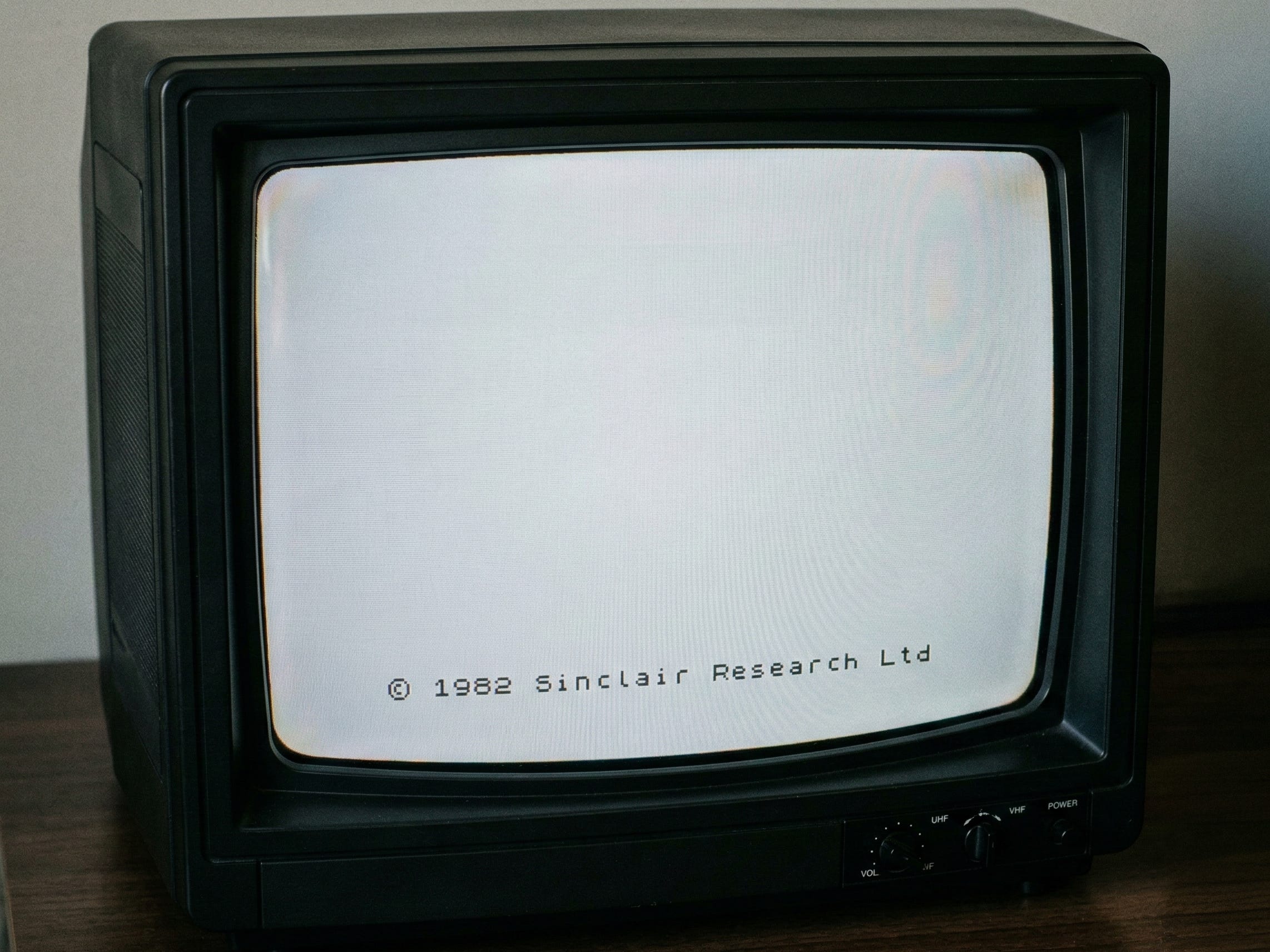
Rewind tape. Press play. Repeat.
Occasionally, I would make an incursion into the living room, armed with cables and power supplies, to hijack the family color set. My family, who quite rightly expected to watch television rather than my experiments in abstract, attribute-powered modern art, were less than thrilled.
Applying for a games job in 1984 didn't involve LinkedIn profiles or PDF resumes, concepts that would have been pure science fiction. You'd find an ad in the pages of Computer & Video Games or Your Computer, type up a cover letter if you had a printer, handwrite one if you didn’t, carefully pack a cassette tape (your demo, always a demo) between two pieces of cardboard in a stationery envelope, and drop it in the postbox. Then you waited. Weeks, sometimes. You had no way of knowing whether it had arrived, whether anyone had loaded it, or whether the tape had been mangled in transit. Faith in the Royal Mail was not optional. If you were lucky, you heard back.
Nonetheless, by early 1984, I had cobbled together a demo. A smooth, sideways-scrolling platformer. It was enough to secure an interview with Software Projects in Liverpool.
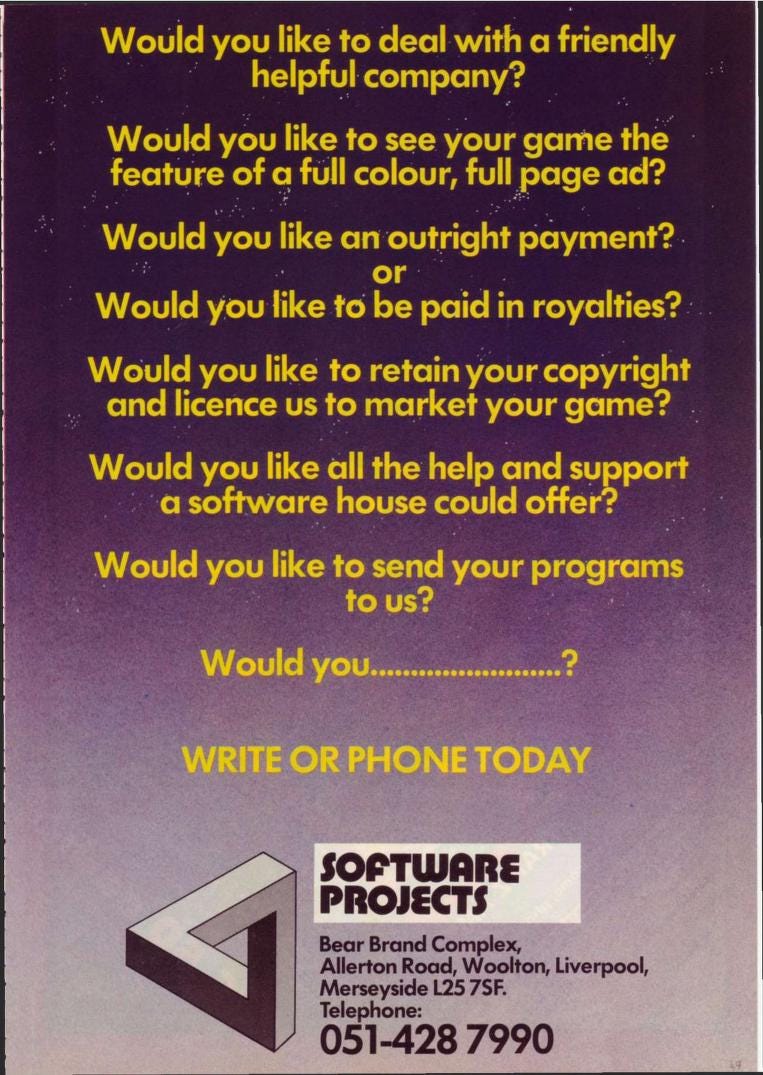
That interview was memorable, mostly because I wasn’t the only one trying to get a job that day.
I arrived at the office to find another candidate waiting. He was a sixteen-year-old kid named Stoo Fotheringham. Stoo was a budding C64 programmer, and he had brought along a friend for moral support. Let’s call him Fred.
Alan Maton, Software Projects’ Managing Director, decided to take us all to lunch at the King Do, a Chinese restaurant in Woolton Village. It was a formal affair. Crisp white tablecloths, polite staff, and a lazy Susan in the center of the table. There was Alan, me, young Stoo, Fred, and a serious software distributor who was visiting on business.
Fred, it turned out, was not shy. He launched into a loud, bawdy story about his time working behind the counter of a computer shop. He was regaling the table with the tale, building up a head of steam, his voice carrying over the clinking of porcelain and the quiet murmur of the other diners.
Just as the demure waitress arrived to place his meal in front of him, Fred delivered the punchline.
“Stick it up your fanny, lady!”
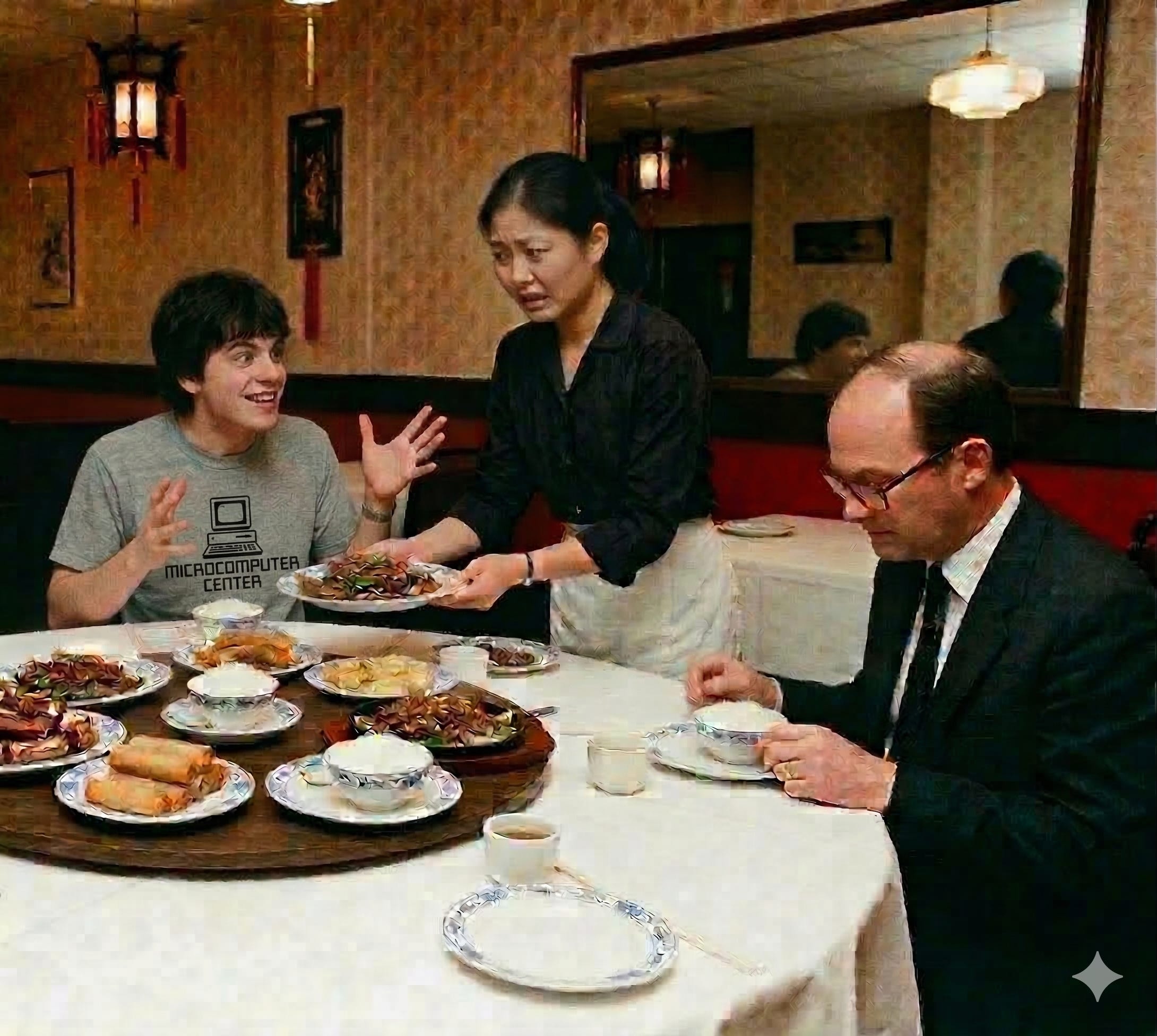
The sentence hung in the air, vibrating with a specifically British kind of obscenity. The waitress froze, the plate hovering an inch above the table. Alan stopped chewing mid-bite. The distributor stared at his rice as if he had just discovered an urgent need to count the grains.
Glances were exchanged across the lazy Susan. I looked at Stoo, who was turning a shade of crimson that matched the decor perfectly. Well, I thought, that's Stoo’s chances gone.
Needless to say, we both got the job. It was, as it turned out, the most important meal I never paid for.
In February 1984, I packed my bags and moved from Barnsley to sunny Birkenhead, setting up residence in a terraced house on Holt Road owned by Alan Maton. Stoo, joining later once he completed his O-levels, soon switched from coding to pixel art, where his talents truly lay. Along with Marc "Wonga" Dawson (now Marc Wilding), a C64 programmer who had joined Software Projects after the collapse of Imagine Software, we formed a tight-knit trio of reprobates.
Software Projects was based in the old Bear Brand Complex in Woolton Village, on the other side of the Mersey from Holt Road. It was a strange place to build the future. The site had formerly manufactured hosiery, and the factory’s ghost was still physically present.
The offices themselves were rigidly divided. The grown-ups, the administrative and sales staff, worked in a later addition that clung to the side of the old industrial section like a barnacle. It had the feel of a definite afterthought, all 1970s fake wood veneer and turquoise carpet. Almost certainly turquoise.
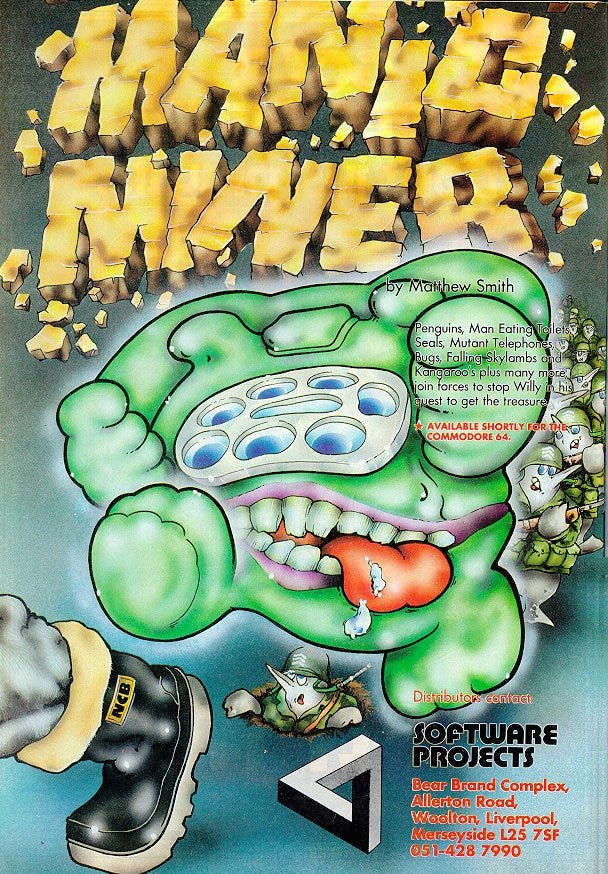
At the back of this extension sat Alan Maton’s office, a space that felt strangely modern, anchored by the beige bulk of an Apple Lisa on his desk. On the wall hung a framed poster of Manic Miner, one of Roger Tissyman’s distinctive depictions of Miner Willy in his NCB boots. I made some comment to Alan about the irony, nodding at the poster. He looked up, suddenly concerned.
“What do you mean?”
It turned out we were talking about completely different things. I meant my own time working for the NCB the previous summer. Alan, it emerged, had heard from the National Coal Board about the unauthorized use of their logo on Miner Willy’s boots.
At the complete opposite end, guarding the front door, was Tommy Barton, Liverpool businessman and third co-founder of Software Projects. His office was a jarring departure from the cheap paneled walls. It was heavily wood-paneled, dark, and imposing. It didn't look like a tech CEO's office. It looked like the captain's quarters of an old pirate ship. If Alan was in charge of the software side of the business, Tommy was the overall boss. The final boss.
I had the sense that our presence in the front office was by invitation only. At times, it was by summons. We developers were housed "in the back", in a completely separate part of the Bear Brand.
We called it “The Zoo.”
It was a cavernous space chopped up by pragmatic construction. A drop ceiling hid the true height of the roof, and the floor space was divided into a warren of tiny offices, partitioned by cheap, fake-wood-veneered walls.
We spent a lot of time in those tiny boxes, mostly because none of us could drive. We were at the mercy of the Merseyside bus schedule. If you missed the last connection to Birkenhead, you weren't going home. You were sleeping on the floor. It happened more than I'd like to admit.
Those nights were fraught with a specific kind of tension. We slept on thin, hard industrial carpet, trying to find a comfortable angle between the desk legs, but the real enemy was the alarm system.
Somehow, it would get armed while we were in there. The sensors weren’t in our offices but in the corridor, which meant that as long as we stayed in our boxes, we were fine. Step out into the hallway to stretch your legs or find a toilet, though, and the sirens would go off. We learned this the hard way, more than once, stumbling bleary-eyed into the hall only to be met with deafening noise and the eventual shuffle of a night security guard coming to reset the panel.
Not every night ended in sirens. One night, the watchman caught us wandering the corridors and, instead of kicking us out, offered to show us a different part of the complex.
He led us into a dark hall in the “old wing.” He swept his flashlight beam across the room, illuminating row after row of silent, heavy machinery. Looms and knitting machines, cast iron giants that had once clamored with noise, now sat frozen in the dark. It was a surreal contrast. We were next door trying to squeeze logic into 48 kilobytes of RAM, while these iron beasts slept in the shadows.
Back inside The Zoo, however, the mystery was less romantic.
At the very back of our workspace stood a set of heavy doors. We were told, in no uncertain terms, that they must not be opened. Naturally, we viewed this less as a safety instruction and more as a challenge.
One night, we found a way in. We slipped through the forbidden doors and found ourselves in a space that felt like it had been forgotten by time. Strange shapes under tarps, broken furniture, damp boxes, and the general rot of a dead factory. It was spooky, unlit, and scary. We poked around for a few minutes, shivering in the cold, before retreating back to the warmth of our computers. In hindsight, it was probably forbidden not because of any great mystery, but because it was a neglected junkyard and almost certainly unsafe.
I was a green twenty-year-old. While I had a partial electronics education behind me, nobody had taught me how to make video games. That had come from blood, sweat, and a lot of disassembled code. Every time I walked into the Bear Brand complex, the same thought followed me in. Today is the day, I would think. Today is the day they realize they made a mistake hiring me. How little I actually knew.
My routine was an exercise in logistical anxiety. I had finally mastered the commute from Holt Road: the train from Green Lane station, rattling through the dark, tiled tube of the Mersey tunnel to Moorfields station, followed by a bus from the city center out to Woolton Village.
Occasionally, I was spared this grind by Alan or Soo Maton, who would offer me a lift. But on a Wednesday afternoon in July 1984, Alan stopped by my desk with a change of plans.
“Hey Steve,” he said. “We can’t give you a lift tomorrow.”
“No problem,” I said, mentally preparing for the bus.
“John will pick you up,” Alan continued. “Be ready at 8:00 AM sharp.”
My stomach tightened. John was John Darnell.
In the hierarchy of the Zoo, John was a heavyweight. He was the C64 specialist. He had been with the company longer than I had, and he was older. He had his own car, which in my twenty-year-old eyes made him a fully formed adult. He was the de facto authority, a 'Senior Programmer' even if we didn't use titles like that. I was scared to death of him.
I spent Wednesday evening dreading the car ride. A lift from Alan was fine; Alan was the boss, but he was management. A lift from John was a peer review on wheels. I imagined a forty-minute interrogation in a confined space. What do you know about interrupt vectors, Steve? How would you optimize this routine, Steve? Why don’t you know that, Steve?
I decided the only defense was punctuality. I would be ready, washed, dressed, and standing on the curb before he even turned the corner. I would not give him a single reason to be annoyed.
I have always been a nervous sleeper, especially when I have an early appointment. I accomplish punctuality not by sleeping well, but by waking up every hour to check the clock.
John at 8. Up at 7.
I went to bed Wednesday night with that mantra looping in my head. I woke up at midnight. I woke up at 3:00 AM. I woke up at 5:00 AM. The dawn broke, the room getting lighter behind the curtains. I drifted into that treacherous shallow sleep where you feel like you’re still watching the clock but aren’t.
And then, the banging started.
I jolted awake. The entire house was shaking. There was a low, rhythmic rumbling, and the windows were rattling in their frames. The bed itself seemed to be vibrating across the floor.
My first thought wasn’t structural failure. It wasn’t a poltergeist. It was pure, irrational employment anxiety.
It’s John.
I looked at the clock. It was 6:56 AM.
Panic washed over me. He’s early, I thought. He’s an hour early, and he’s furious.
In my sleep-deprived delirium, the physics of the situation didn’t matter. The fact that a human being couldn’t physically shake a brick terrace house by banging on the front door didn’t occur to me. All I knew was that the house was vibrating, which meant someone was angry, which meant I was in trouble.
If I ignore it, I thought, pulling the duvet up to my chin, freezing like a prey animal, maybe he’ll go away.
I lay there, petrified, waiting for the sound of the front door splintering. And then, as quickly as it had started, the shaking stopped. The rattling ceased. The house settled back into silence.
I lay there for a minute, heart hammering against my ribs, waiting for the doorbell. Nothing. I crept out of bed and checked the window. Holt Road was empty. No car. No furious John Darnell.
I looked at the clock again. 7:00 AM.
I got washed and dressed in record time, fueled by adrenaline. I paced the living room for an hour. At 8:10 AM, a car pulled up. It was John. He looked calm. He didn’t look like a man who had been trying to batter my house down an hour earlier.
I got in the car, murmuring a polite “morning,” and braced myself for the interrogation. But the interrogation never came. We drove to Woolton Village in relative silence, the radio humming in the background.
When we walked into the Bear Brand complex, the office was buzzing. People weren’t at their desks; they were standing in clusters, holding coffee cups, talking excitedly.
“Did you feel it?” someone asked as we walked in.
“Feel what?”
“The earthquake! The Big One!”
I stopped dead. “Earthquake?”
“Just before seven this morning,” they said. “5.4 on the Richter scale. The epicenter was down in the Lleyn Peninsula, but it shook the whole city. Chimney pots fell off in Liverpool. My whole house was shaking!”
I stood there, blinking. So that’s what it was!
It wasn’t John. It wasn’t my incompetence coming back to haunt me. It was a geological event. I sat down at my desk, loaded my assembler, and felt a strange sense of relief.
I never told John.
It was, as it turned out, the largest earthquake to hit Britain in decades. At the time, all I knew was that it wasn’t my fault.
For a job in the games industry, there had been remarkably little game development so far. That would change soon enough.
This chapter is the fourth part of an ongoing series. An evolving list of chapters is available on the contents page.
For me, started in 1980 (early high school) with a 48K Apple II Plus, single 5.25" disk drive, monochrome green monitor. First BASIC, then some Pascal (since Wizardry was written in it), and finally 6502 with the S-C Macro Assembler. With no Internet, we had to scrounge everywhere for magazine articles and obtuse technical manuals - like everyone else back then. Great days!
Another delightful chapter, extremely well-told, as usual! I'm delighted to see that @stoomonster gave a Like to this. As we were introduced to Stoo, I thought, "That is one of the coolest names I've ever heard!"; Don't ever stop writing, Steve!