

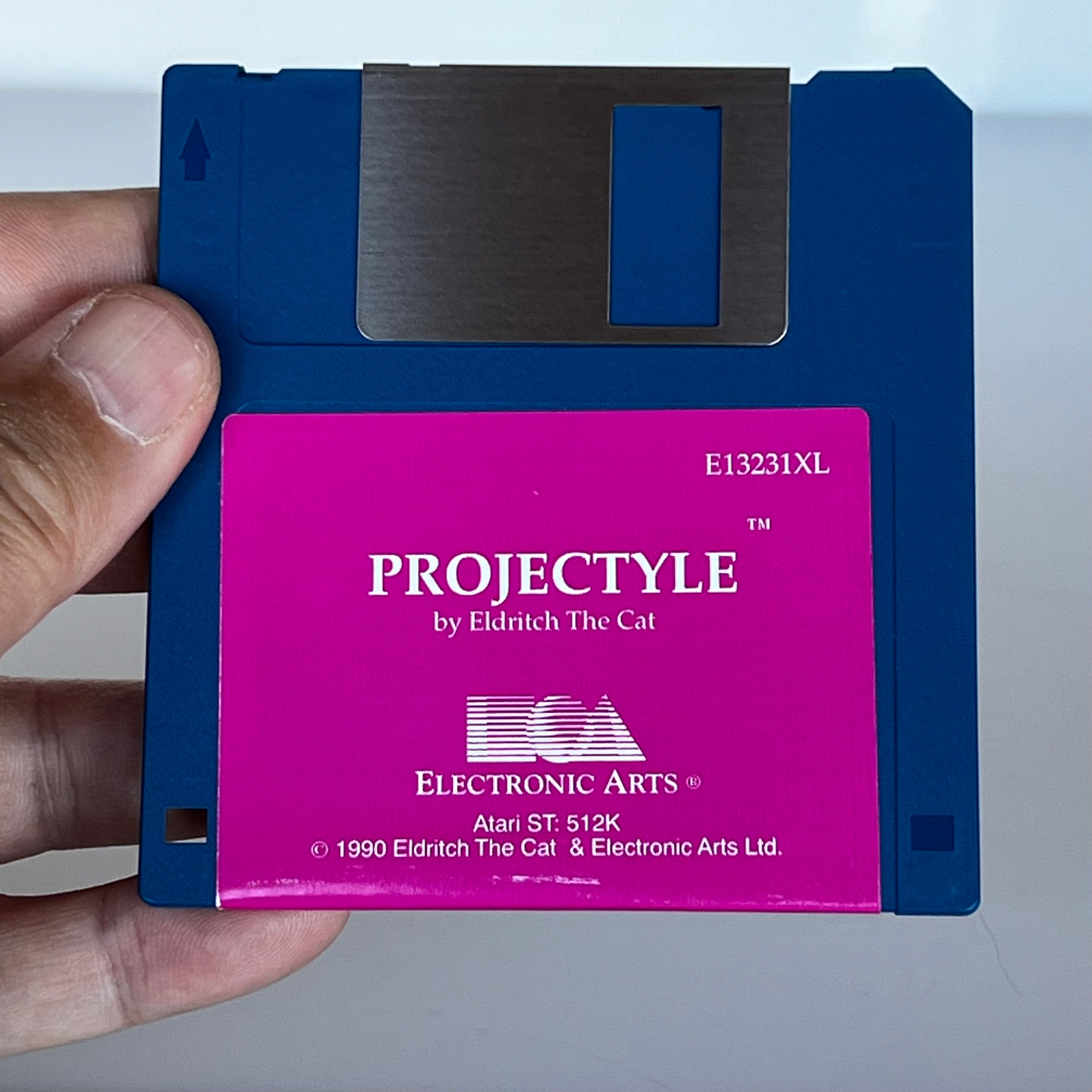
As 1989 rolled around, our fledgling development studio, Eldritch The Cat, was off to a good start. We had a full slate with two signed games in development: Marc working on Astaroth for Hewson Consultants, and me working on Scrollerball (Projectyle) for Electronic Arts, both games on Amiga and Atari ST.
The Scrollerball contract was organized into milestone-based payments. We signed it in December 1988, and it began with a series of gameplay milestones for the Atari ST, leading up to Alpha (feature-complete) in June. The Amiga version would follow.
It is quite evident, reading the contract now, that the design was far from locked. This would bite us in a number of ways as we developed the game: while the design flexibility was nice, the payment structure and milestone dates were very rigid. Crucially, the contract does not mention supporting three simultaneous players. Additionally, while a league system is mentioned as a deliverable, the contract does not mention a player training system or league variants such as elimination modes.
It is ironic that three-player functionality is not mentioned in the contract because, if you’ve ever seen Projectyle, you’ll know that it is a core and defining feature of the game. In fact, it almost defined the actual name of the published game! Projectyle was not yet a “game of three halves.”
I threw myself into the game’s technical development.
As I’ve mentioned previously, there were two pitch demos for the game, the first demonstrating scrolling tech and the second demonstrating colliding ball physics.
My initial focus was translating the second demo’s ‘oblique impact of N spheres’ bouncing balls logic from ST BASIC. The finished game is played like Subbuteo meets Air Hockey but with three players in a multi-zoned arena. In my first few years of developing games, I didn’t have much reason to use actual math beyond simple arithmetic and logic, but I had done a fair bit of math in school. By 1989 I was a few years out of school, and I remembered bits and pieces: basic Pythagoras, a couple of useful sine and cosine identities, and basic equations of motion; however, the glue holding these things together in my memory was losing its adhesion! For that ST BASIC demo, I’d gone to the library in Liverpool’s city center (no World Wide Web yet!) to refresh my memory. A few high school physics books later, I’d figured things out well enough to create the bouncing balls pitch demo, and now it was time to implement that logic in fast 68K assembly language.
Naturally, in addition to a ball (puck, projectyle, etc.), Scrollerball would need some scrolling! The previous four games I’d worked on were all built around efficient ways to move scrolling backgrounds around the screen, the most recent being the abandoned Gargantuan game at Denton Designs. I won’t get into much technical detail here, but on the Atari ST, using pre-shifted blocks solved horizontal scrolling, and vertical scrolling was easy. The Amiga was a different matter, but I pushed those thoughts out of my head until later; I’d worry about the Amiga once the Atari ST version was complete.
The initial graphics for Scrollerball were done by Stoo Fotheringham, who created multiple player and arena graphics sets. We had hoped to have a complete set of art for the game by Christmas 1988, but Christmas came and went, and the art was not done. Additionally, based on feedback from EA, it became clear that we’d need a lot of iteration on the art to satisfy their expectations. With our art budget mostly depleted and EA offering no further art funding, we were forced to place Stoo on hold. Ultimately, I took on most of the remaining in-game art tasks, building on what Stoo had done, with Marc pitching in where necessary and a certain Elsbeth Jones handling the additional player profile pics and animations deemed necessary for the training modes and game interstitials. Needless to say, we had woefully underestimated the art needs, mostly due to the lack of initial design lock.
Stoo is not credited in the final game but should be recognized for creating the initial graphics. That said, I spent hours and hours working on pixel art for the players, arenas, and logos. Much of it was technical art: as I evolved the capabilities of the graphics tech, it became possible (and necessary) to change the art; however, there isn’t a piece of in-game art I didn’t pixel-fuck. Over and over.
We were in a similar situation with the music and sound effects: no budget. I talked to one or two local Liverpool musicians, but it was clear we couldn’t afford to contract out the music.
In my infinite wisdom, I decided to take on all music composition duties. And sound effects. I had previously created a small amount of music for games, starting with Jet Set Willy on the Amstrad CPC. This should be doable.
And in my even more infinite wisdom, with EA enthusiastic about the idea, though not offering any additional budget, why not give each of the eight teams their own theme tune?
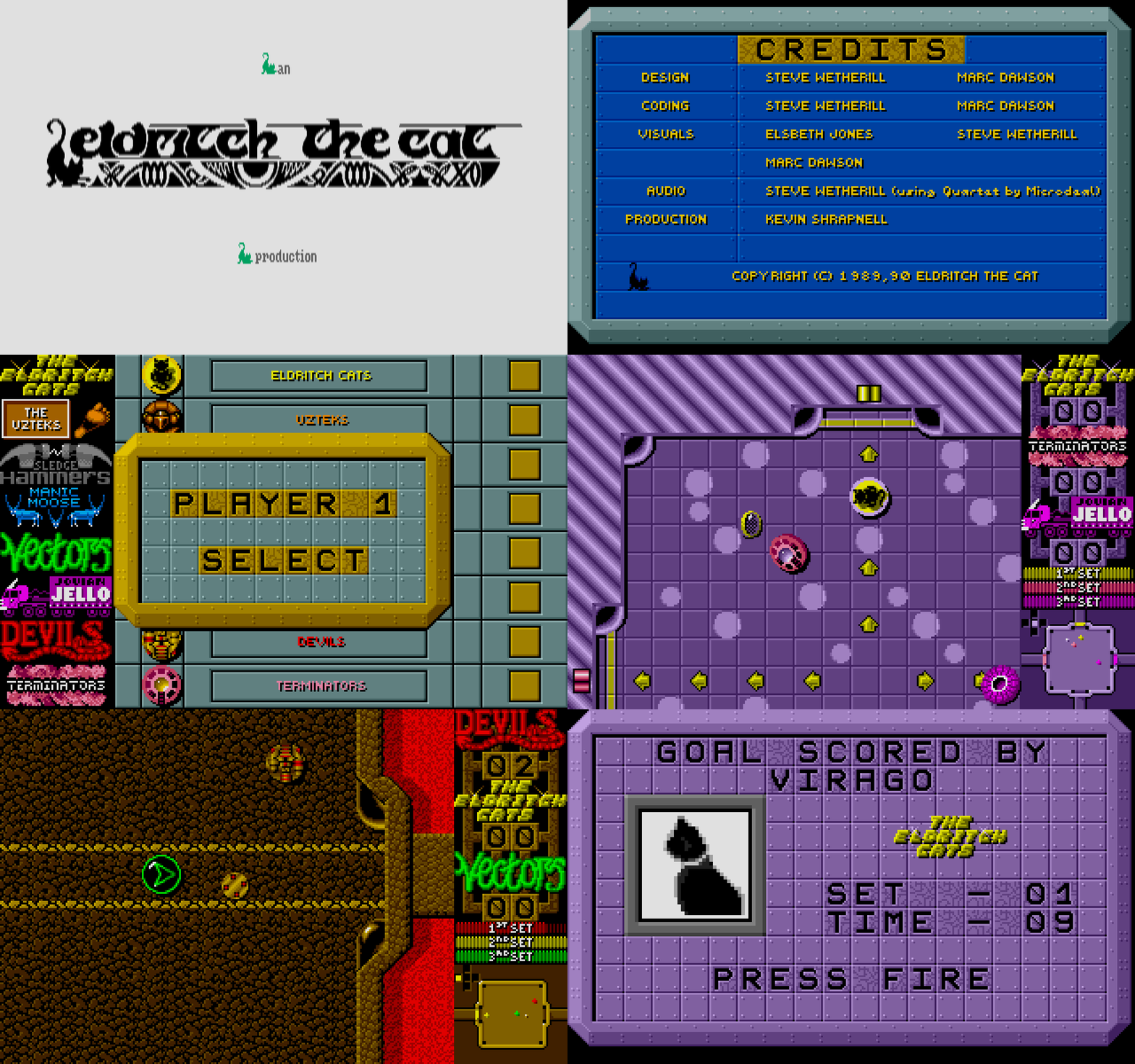
In the end, I created eight tunes using Quartet on the ST. Quartet came with a player for the ST that delivered four-channel digital audio by abusing the volume registers on the AY sound chip. Unfortunately, this took 100% of the CPU, meaning the game couldn’t do anything else while the music was playing. We did at least have music on the main menu, cycling through the eight different tunes.
Another snag with this plan was that there was no Quartet player for the Amiga. The solution turned out to be gallons of coffee, Def Leppard’s Hysteria CD on repeat, Devpac, and a long overnight session disassembling the ST player and then creating an Amiga player which used the Amiga’s Paula sound chip. By the next day, I had a Quartet player for the Amiga. Regular game development could continue.
To my ears, the music on the Atari ST version sounds better. The unavoidable distortion generated by the Quartet player introduces a certain density into the sound.
The Amiga’s Paula sound hardware didn’t consume much CPU while playing music, so on the Amiga, we could have music while the game was playing. In case the in-game music gets repetitive, thankfully there’s an option to turn it off. You can thank me now.
I’ve received positive feedback on the music over the years, including from a professional musician who told me Projectyle inspired his own music journey. Feedback like this is always disarming, because I was just a starving coder in a garret, trying valiantly to check all the boxes and make a ship date.
Astaroth was primarily Marc’s project, and he handled it from soup to nuts, so I don’t have much to add firsthand. It was completed in the spring of 1989.
Since Scrollerball was barely covering its own costs, if that, we needed to boost studio cash flow by finding a second project for Marc. I’ll catalog below just some of the things we tried.
Heart of Yesod was to be a 1989 16-bit follow-up to Nodes of Yesod and Heartland.
Colin Grunes hadn’t been involved with Eldritch; the last time I’d worked with him was at Denton Designs the previous year. But I could imagine Colin’s unique, recognizable graphics rendered in full color on the 16-bit machines, so he and I chatted, and he came up with several animations based on the well-known Odin games. Marc was to be the lead developer on this game, but I took it upon myself to come up with the backstory: protagonist Charlie travels from world to world via a magic wardrobe, with a new costume in each world. Mr Benn meets The Lion, the Witch and the Wardrobe meets Heartland. I also set about writing the demo to show off to publishers. The demo featured smooth, full-screen vertical scrolling, platforms, and colorful, animated, Odin-esque sprites from Colin. We made a printed design document and took the demo to London to visit various publishers. Our game design doc proudly stated, “Heart of Yesod,” and we probably tried to smooth over the little matter of intellectual property. Paul McKenna of Odin was not involved, and we certainly didn’t have permission to use any Odin IP. We figured that a cool-looking demo would be enough, and the names could be changed later to protect the innocent. The name Heart of Yesod left no doubt whatsoever where the game was coming from: “Art by Colin Grunes! Coding by the Nodes of Yesod, Robin of the Wood, and Heartland team!”
To cut a long story short, it quickly became clear that nobody wanted to touch this IP with a 10-foot pole, and we dropped the idea.
I can’t really explain why I was so involved in the demo and backstory; surely I had enough to do on Scrollerball? Probably a triumph of the wanna over the shoulda. A wannashoulda, if you will. Nothing remains of the demo, but I do have a copy of the backstory document.
Colin’s work on this game would be his last brush with the games industry.
We made another effort to land an additional game when Ultimate resurfaced as Rare and started doing press in the popular game magazines, talking about their Razz arcade board.
Somehow, we managed to get through to Rare on the phone, probably by mentioning Odin Computer Graphics, and secured a meeting with Chris and Tim Stamper at their offices near Twycross. Result!
We created a paper design document and concept art for a game called Special Eyes, featuring a range of eyeball-shaped characters, each with a unique look and abilities; each character was “specialized.” It seemed like a good idea at the time, even if the name does sound like a high street optician chain. I don’t remember the proposed gameplay, but it was probably some sort of side-scrolling game.
Marc and I set out on a combination of trains, buses and taxis from Liverpool to Twycross.
The Rare HQ at Manor Farmhouse was an old manse converted to offices. We had a nice meeting with Chris and Tim; Chris was more supportive, using expressions like ‘when you get to work on the Razz board,’ but Tim came across as more skeptical. We didn’t get a chance to pitch our game, and we didn’t show any of the artwork we’d prepared. In retrospect, they were protecting their business by approaching things that way; we were probably a little gung-ho. Our meeting lasted 30 minutes, and after an awkward “Oh, you don’t have a car?” they graciously arranged for a ride back to the train station. And that was the end of that!
Of course, we were disappointed. We hadn’t wanted to visit Rare empty-handed, but Special Eyes was probably more form than function. We’d probably have been better off just presenting ourselves rather than a half-baked game idea. I was particularly disappointed because I’d played the Ultimate games avidly, and they were one of the inspirations that got me into the business. Still, at least I got to meet two of my heroes!
I did the majority of the work creating the design document for our game. I hand-painted all the Special Eyes art, too. More wannashoulda, and there was surely a knock-on effect on Scrollerball’s progress. A theme developing here. At least I didn’t commit to building a software demo this time.
I was enjoying the Michael Moorcock books featuring the Eternal Champion characters Elric of Melniboné et al., and admiring artist Rodney Matthews’s visual renderings of some of these characters. We pitched EA a much grander design: picking up the license and developing a video game based on the Moorcock characters. Our Scrollerball producer Kevin Shrapnell and his boss, VP of Development Joss Ellis, were very interested in exploring this idea. So our people contacted their people, and initial conversations were had. I’ll note that Marc and I were not part of our people and did not participate in those conversations, but conversations there were, nonetheless.
EA also reached out to Rodney Matthews, but he was, for some reason, dead set against being involved with video games.
On the tech side, even though I was supposed to be working on Scrollerball, I found myself exploring a couple of technical approaches we could use in a Champions Eternal game. One was a top-down sprite rendering engine that could rotate sprites around a centroid using affine transformations, giving very smooth rotation without storing pre-rotated animation frames. We called this Scrotation for scrolling and rotation. And yes, because childish humor.
The other tech I worked on was a 3D fractal landscape generator.
In June 1989, Moorcock did a book-signing tour to promote the paperback release of his novel Mother London. He stopped at Chapter One Books, a Liverpool bookstore at the bottom of London Road, near Lime Street. Of course, Marc and I went along, fully planning to introduce ourselves, but I’m sorry to admit we bottled it; I just bought a copy of his book instead, and he signed it.
Joss and Kevin also visited Eldritch HQ at Croxteth Park to discuss Champions Eternal. We’d agreed to meet at the Rocket pub just off the M62 in Childwall, Liverpool. As Joss’s Nissan 200SX pulled in, with Kevin in the passenger seat, it dawned on us that there had been a slight miscommunication. We’d made it to the Rocket by bus and on foot, but Joss and Kevin were expecting to follow us back to my place. As a result, we two 6-foot-something lads ended up somehow sardined into the virtually nonexistent back seats of Joss’s car for an uncomfortable and embarrassing ride back to HQ. We must have looked ridiculous; I don’t know how we got into that car.
And as you’ve probably gathered, dear reader, the Champions Eternal game did not go forward. I don’t think it was the car ride; EA wasn’t able to reach terms with Moorcock’s agent, putting the final nail in the coffin for Champions Eternal, which survives only as a ‘the three who were one’ nod in the Projectyle manual. Easter egg.
More wannashoulda, I’m afraid. More significant, this time.
Meanwhile, in mid-1989, Marc and I were introduced to a young programmer named Mark McCubbin, who worked at Denton Designs with Stoo Fotheringham and co. Mark had a reputation for being both really fast and able to write highly performant code. He was looking for additional work, so we gave him a chance to write a demo for a game idea we had kicking around. Mark came to my house one evening, and we tasked him with writing a routine to rotate the whole Atari ST screen about a midpoint. For the next few hours, Mark set to work, chugging his trademark 1-liter bottle of soda in the process. Nothing came of this initial encounter, but later, Mark would develop the Atari ST port of Shadow of the Beast for Psygnosis. That game would ultimately be credited to Eldritch The Cat. We didn’t know it yet, but Mark would play a big role in Eldritch’s future.
To state the blindingly obvious, our efforts to secure another game significantly delayed the development of Scrollerball. I’d estimate that the schedule impact ran into months, not weeks or days, and this was on top of the scope creep I’ve mentioned with audio, art, and core game design.
On the game design side, the most drastic schedule disruptor was the decision to make Scrollerball a three-player game. This design change affected everything in the game, from graphics development to arena layout to how the league system worked to how we developed and tested support for three simultaneous players. Not to mention player AI for the single-player mode. Three-player support required third-party peripheral hardware (or one player on a keyboard and two on joysticks).
Another significant addition was player training and all the attendant stats and UI that came with it: “It will not sell in the US without these features.” That, and the introduction of multiple league modes, including elimination modes.
I think the game improved with these features, and I remember many conversations with EA about funding the scope changes, but we were in a chicken-and-egg situation: the game was slipping and apparently needed more money at the same time. We really needed to bring more business acumen to bear, but we were in the thick of it, so we just soldiered through.
Ultimately, Marc and I were left with only one sane option: we’d drop the idea of finding another game, and both commit 100% to working on Scrollerball full time to get it to the finish line. Marc took on all the out-of-scope player training systems and UI, the league and knockout mode UI and all the systems behind them, and all the intangible stuff that comes along for the ride.
This decision wasn’t an easy one financially. It would all but guarantee our business would run at a deficit for the next few months. But this EA-published game was our biggest chance, so we really committed to it.
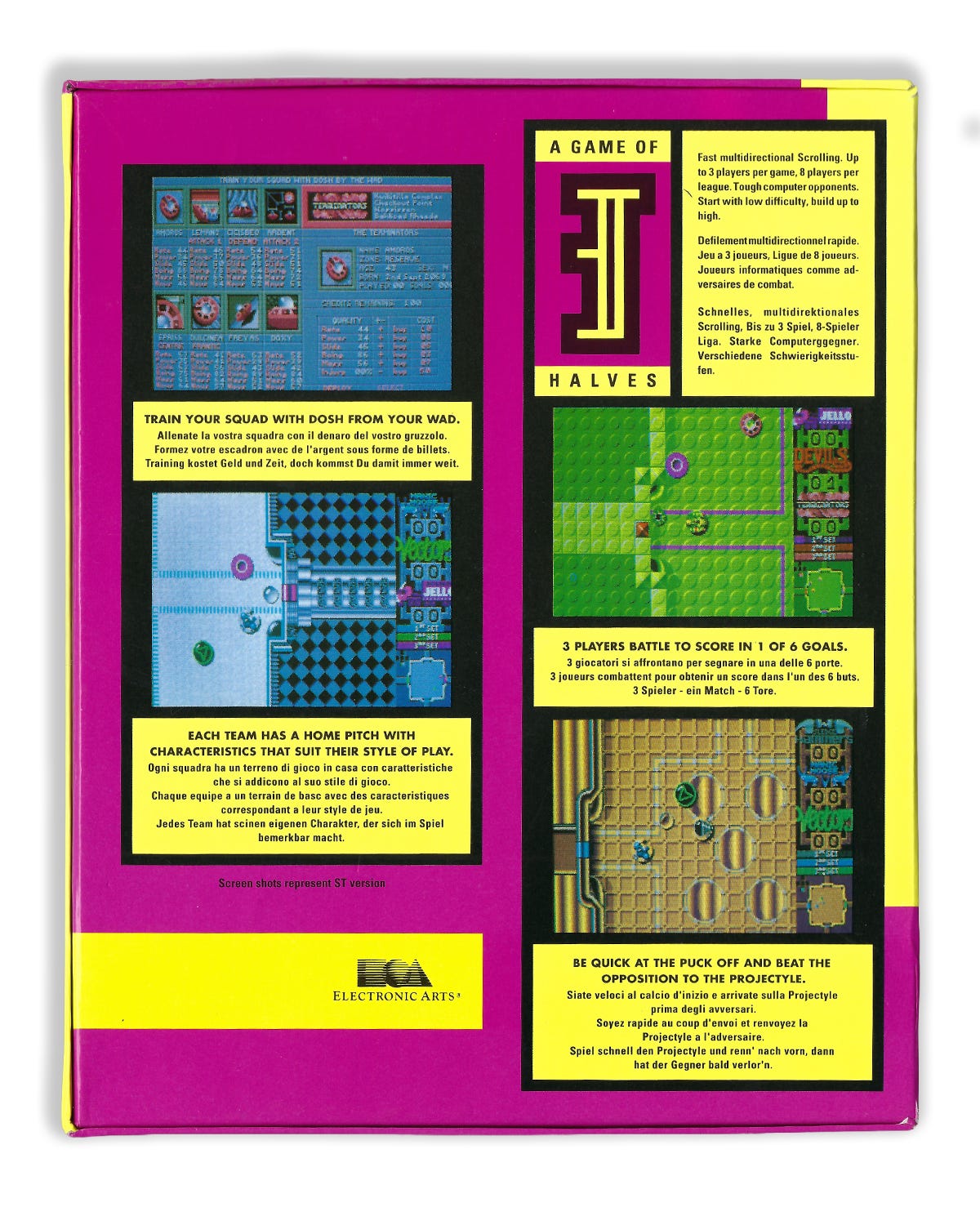
As for the Projectyle name, there’s a story there. During development, the game was simply Scrollerball. We guessed that this would change for the commercial release, and sure enough, as we approached the final period of development, the name-change conversation happened. Tribal would be the new name. Named for the three and the ball. Puck, ball, whatever. Three ball. Three players. And the teams are like tribes. Right?
Tribal.
And this was the new name for a time. But then, wait! A new name! And we were sent the loading screen image that EA had commissioned separately, and it had the new name:
Projectyle.
Not merely Projectile; no, Projectyle. With a Y. Much more fitting! Except that, in the game’s manual, you are playing Tribal. With its own pulp fiction trash sci-fi backstory. Such as it was. So the product is called Projectyle, but in Projectyle you’re playing Tribal. And in Tribal, the players are fighting over the Projectyle. Got it?
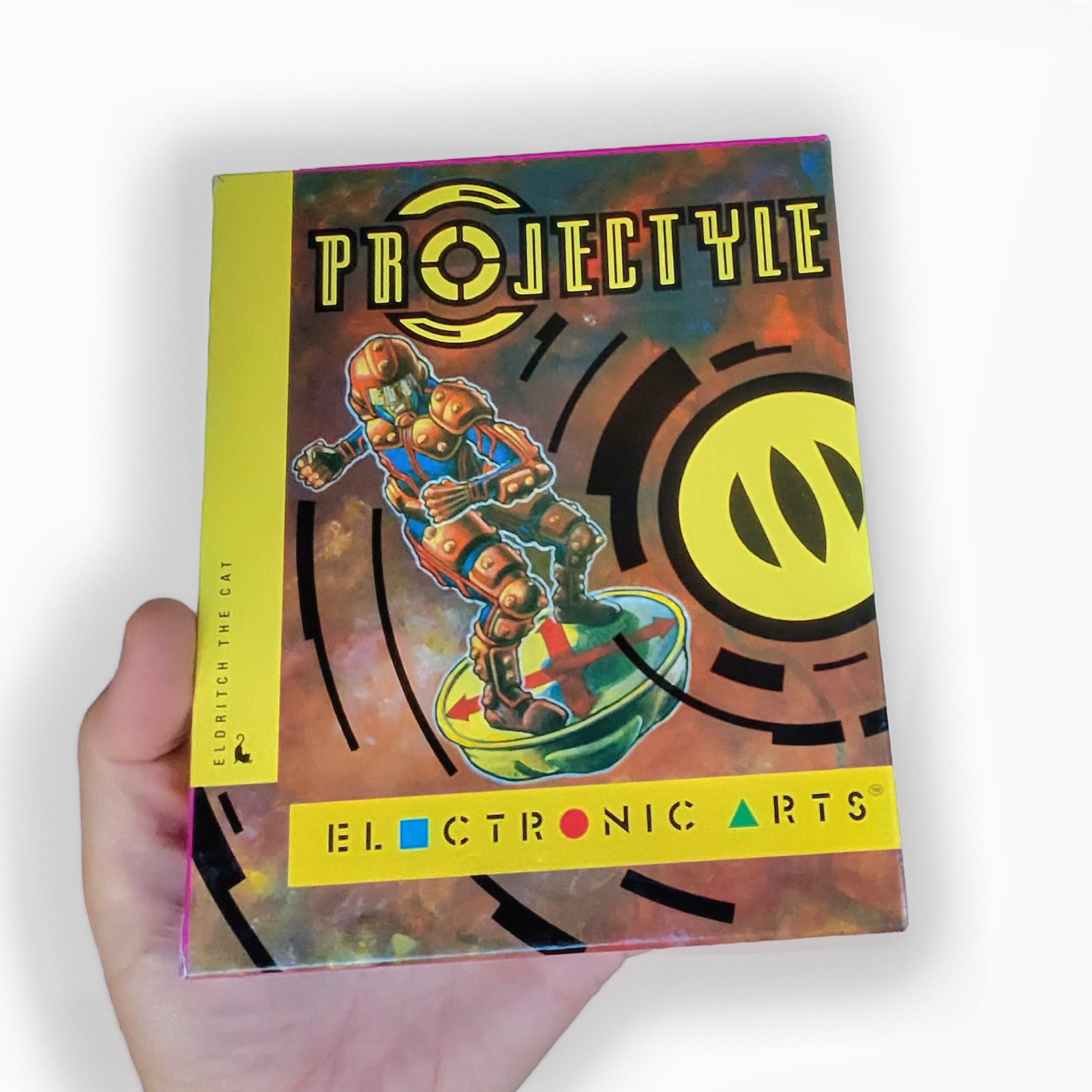
In March or April 1990, we were approaching the finish line with Projectyle. The Atari ST version was complete and ready for mastering; however, we hadn’t finalized the Amiga version. Not quite. What remained on the Amiga was to create the mastering program, and then both the Atari ST and Amiga versions had to pass the final EA QC checks, with any bugs discovered in the process fixed.
As the drop-dead date for the Amiga version approached, Kevin said he thought it would be best to finish the game in the EA office in Langley. It was strongly suggested that Marc and I should both be present and stay until we completed the game. This meant boxing up all our development kits, monitors, Amigas, Atari STs, and everything else. And with that, Marc and I were summoned to the EAUK HQ at Langley Business Centre on Station Road, Langley, near Slough.
Kevin would drive up to Liverpool to collect us and our development kit, then put us up at his house in Datchet, near Slough, for a few days.
Marc and I once again made our way to the Rocket pub where we’d meet Kevin. To make sure he’d have enough room for our gear, Kevin had borrowed EAUK Big Boss Mark Lewis’s new company Mazda. The plan was to pick us up, collect our gear, and then immediately head back down to Slough. As we pulled out of the pub car park and headed along Queen’s Drive, I realized Kevin probably needed directions and piped up, “Oh, you’ll need to take a right up at the next roundabout, Childwall Fiveways, to keep on Queen’s Drive!” With a glance over his right shoulder, Kevin switched lanes to position us for the upcoming roundabout; unfortunately, this put us directly in the path of an overtaking vehicle, which must have been in our blind spot, and we collided with a BANG! followed by bone-crunching scraping sounds. Nobody spoke for a short while as Kevin pulled over to the side of the road to exchange details with the other driver.
We were all shaken up, but fortunately the only injury was to Kevin’s pride. Mark Lewis’s Mazda couldn’t quite make the same claim; Kevin would have some splainin’ to do when he got back. The Mazda was still perfectly drivable, but the whole driver’s side was banged up. After swapping particulars with the other driver, we continued on our way to Eldritch HQ to pick up our stuff. It was not the most auspicious start to the final push to get Projectyle out the door.
Ensconced at the EA office, we made significant progress and completed the Amiga version of the game in a few days. Those days were a blur, with the coffee on tap in the EA kitchen and all the crunching in unfamiliar surroundings.
With development complete, it was time for the final QC session to ensure Projectyle was ready to ship. The game supports an eight-player league mode, but QC did not have eight people available to play that mode to completion. We decided the EA internal dev team would pull a late night, with plenty of pizza and caffeine on hand, and eight of us would play through the league in its entirety: about 32 three-player games in total, if my math holds. Since the game also supports three players simultaneously, this led to some boisterous ‘encouragement’ as each team’s fortunes ebbed and flowed through the league matchups. We laughed. We cried. We made up nicknames for the in-game players as their cameo animations played when they scored. Rocking Rojo sticks in my memory!
Then, a couple of hours into testing, the disk drive had a wobbly moment. The Amiga had trouble loading the game, and we could all hear the rhythmic cycle of the heads grinding as the drive retried. We all looked at each other in sudden silence. And then, the game loaded! We cheered as we continued with the league games, which led to an overall winner (I forget who) and a successful outcome after hours of testing! I can’t remember everyone who played that session of Projectyle that night, but the players included Kevin, Rupert Easterbrook, Matthew Webster, Scott Probin, Marc, and me.
The next day, we organized a trip to the disk duplication facility, and off Kevin, Marc, and I went to oversee the final mastering of the Projectyle disks. One of the many topics we discussed with Kevin as we drove was ‘the next game’; evidently, EA was happy with Projectyle, at least on that basis. I remember suggesting we make a game called Sucktyle, a future sports game featuring vacuum cleaners. For some reason, the name didn’t seem popular, and Kevin remained unconvinced by the vacuum-cleaner-based game mechanics I was proposing. So, not that one, then. The other idea we discussed was a game about pathetic superheroes. What if, we wondered, there was a league of superheroes, but they had pathetic superpowers? A Free League of Pathetic Superheroes, as it were. What kind of game would that be?
Other large changes were afoot at Eldritch The Cat. Our little studio was about to go legit and enter a season of growth.
This chapter is the fourteenth part of an ongoing series. An evolving list of chapters is available on the contents page.