

After Odin folded, Marc Wilding, whom I’d known since the Software Projects days, did not stand still. With Army Moves wrapped for Ocean, he went a step further and successfully pitched Hewson Consultants on an original game, Astaroth, for the Atari ST and the Amiga.
My own independence journey wasn’t as far along. I was fresh out of Denton Designs, with nothing yet lined up. But we were both free agents at the same time, which allowed us to make good on what we’d agreed over that beer in the Mardi Gras: we’d stop being other people’s programmers and set up shop on our own.
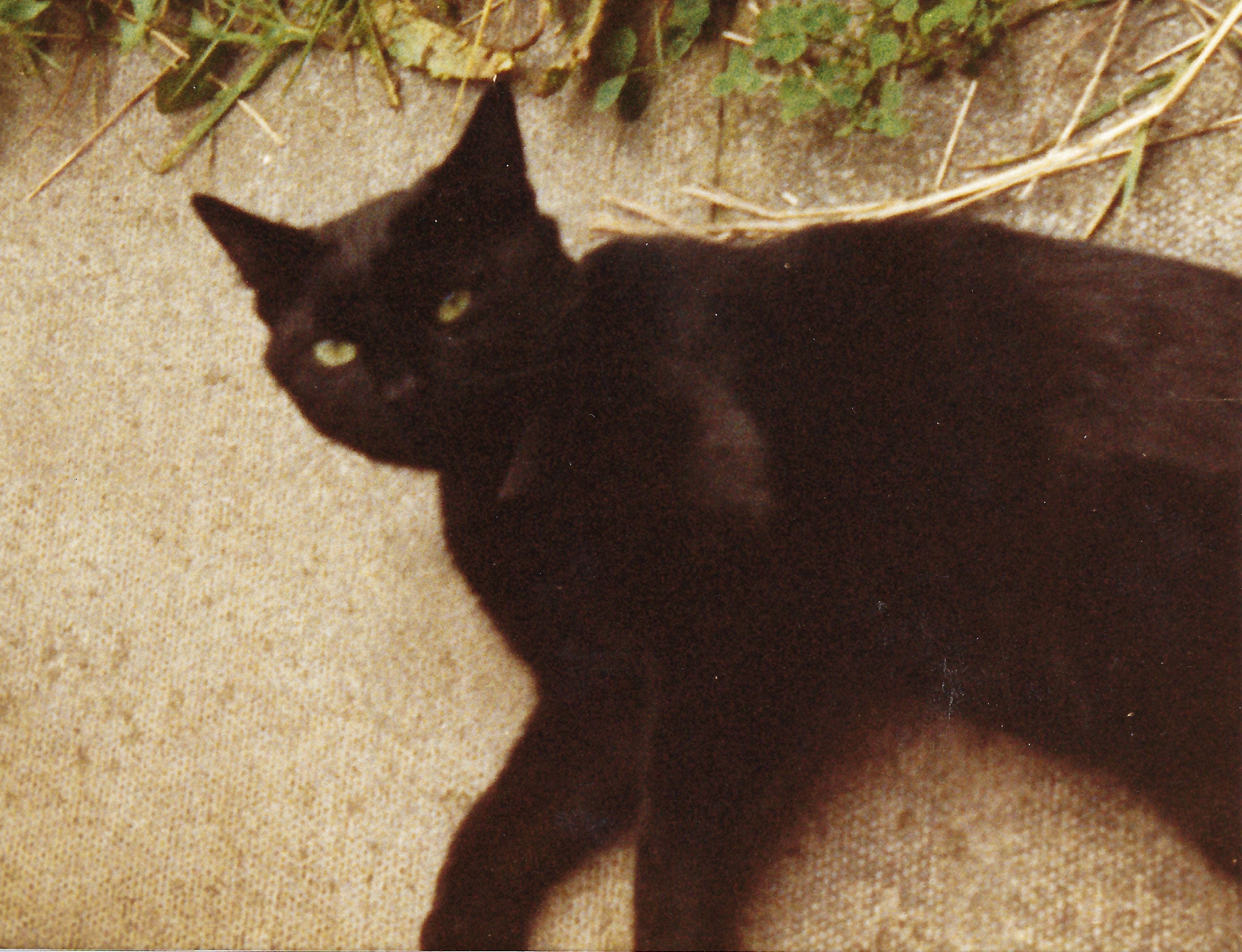
We called our new studio Eldritch The Cat, after my cat, Eldritch. The cat. Gone, but not forgotten.
There was nothing grand about the setup. We worked out of my house in Croxteth Park, Liverpool 12, with the graphics side of things contracted out to people who could draw, which was not us (in theory, at least). Two programmers, one bedroom each in my house for an office, and whatever projects we could line up between us.
Marc brought Astaroth in under the Eldritch umbrella, which answered half the question of what our new company would actually do. He was already fully engaged in the game, handling coding and design, with contracted help in art and sound. Half a question remained unanswered, and the studio’s founding task became simple: find a project for me.
The official version of all this, such as it is, survives in the bio Marc and I wrote for one of our later game manuals. It reads just about how you’d expect from two programmers asked to describe themselves, but the opening section is at least factual:
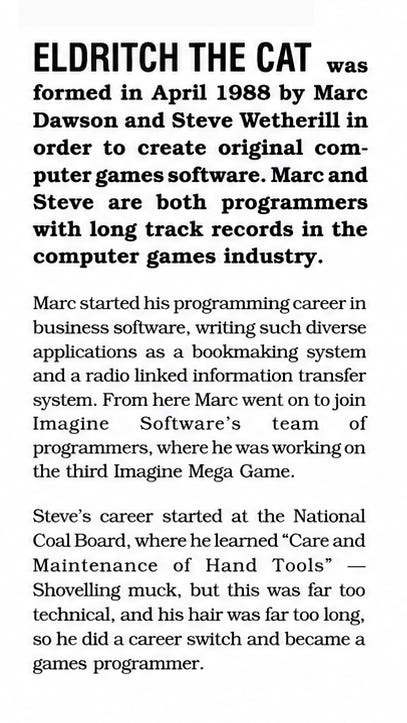
Regarding the “Long track records,” we were both in our mid-twenties, but it sure seemed longer! There’s more to explore in the printed ‘bio’, but that’ll save until later.
So that was our company. A name borrowed from a cat, a house in Croxteth Park, one game already underway, and one programmer still in need of something to build.
Founding a company in April and finding work for it are two different things, and most of that summer and fall was concerned with the latter.
After Dentons, money was scarce to the point of comedy. How I kept myself fed and the bills paid through those months is now a little hazy. I remember Marc and me traveling over to Birkenhead to meet the manager of the Midland Bank branch where I had opened my personal bank account in the Software Projects days, possibly to arrange a small business loan, but if there was one, it cannot have gone far.
I still did not drive, so I traveled by bus or train when I could and walked when I could not. For a time, the nearest place to buy groceries was the Fives on Muirhead Avenue, a Georgian-style terrace of five shops set amid the housing of Norris Green, two miles from my house. I would walk there, fill a bag or two, and carry everything back the two miles home. The number 18 Liverpool bus sometimes ran the full length of Fir Tree Drive to the stop near my house; at other times, it went only as far as Muirhead Avenue, leaving me with much the same walk. Looking back, it is no wonder I was so skinny.
Elsbeth and I had been seeing each other since I got back from the States the autumn before. That summer, she was going to Spain for a fortnight, to L’Estartit on the Costa Brava, with her family. They were taking the long, or at least slow, way round on a quintessentially British package holiday: more than a thousand miles by coach from Liverpool to the south coast, ferry across the English Channel, then another coach down through France and over the border to L’Estartit on Spain’s northeastern coast. Her family, whom I had met and got along great with, were happy for me to join them. There was just enough room for me in the apartment they’d booked, provided I was OK with sleeping on the sofa. I was, so the only remaining problem was how I’d get there: the coach package was fully booked, with no seat left for me.
What if, I wondered, I could find and pay for a flight? Perhaps I could just fly out and meet them there? I went into the Thomas Cook office just off Ranelagh Street in Liverpool and asked, with more confidence than accuracy, about flights to “Esta Tit.” Once the travel agent had corrected my pronunciation, I was informed that an economy return flight landing at Girona airport, somewhere said to be quite near L’Estartit, would be £150.
That left the small matter of finding £150. I remembered a little computer shop in Southport that bought and sold second-hand equipment, and I still had my old BBC Model B from the Odin days, along with its Z80 second processor and twin external 5¼-inch disk drives. This was the machine on which I had written Nodes, Arc, Robin, Heartland, Sidewize, and most of Crosswize. By the summer of 1988, though, the BBC gear already felt like yesterday’s tool. I was a sophisticated 16-bit developer now, dammit, and I’d moved on to the Atari ST and Amiga.
The next hurdle was getting it all to Southport. Have I mentioned that I did not yet drive? I packed the BBC, the Z80 second processor, and the dual disk drive into plastic carrier bags, probably from Kwik Save, and lugged them onto the number 18 bus from Croxteth Park into Liverpool. I met Elsbeth at the bus station, and with bags full of BBC hardware, we boarded the double-decker that would take us up the coast to Southport.
We climbed the stairs and claimed the coveted front seat on the upper deck. It’s a thing. The huge windows gave us an unobstructed view of the road ahead as the bus made its way towards Southport, while the computer that had carried me through most of my Spectrum years traveled along in its Kwiky bags.
At Southport, we exited the bus and made our way to the computer shop, still carrying the separate pieces between us. I no longer remember the name of the place, but I remember going in with the BBC and all its attachments and coming out without them. The shop gave me almost exactly what I needed for the airfare.
Getting to Girona would test the theory of how “quite near” it was to L’Estartit. I had never traveled to a country where I did not speak the language, unless Wales counts. My only Spanish was from a touristic phrasebook. I flew from Manchester on my 10:00 pm red-eye flight into Girona, expecting to spend the night in the airport, and assuming, on the strength of my vast international travel experience (a single trip to America the year before), that the airport would have at least a café where I could sit out the night.
Girona airport was shut. Completely.
I waited for dawn.
When the airport began to rouse from its slumber, the taxi rank opened before anything else. I ended up sharing a cab with some fellow travelers who were heading to the train station for Barcelona. I had read that the Girona train station was adjacent to the bus station where I could catch a bus to L’Estartit, and figured that by sharing a taxi I’d save on the fare. It did not dawn on me to ask which train station the taxi was headed for. After a short ride, we arrived. My heart sank as I clambered out of the taxi and found myself at the nineteenth-century red-brick station at Caldes de Malavella, surrounded by fields, rather than the ancient walled city of Girona I had been expecting.
As I stood there, confused, my fair-weather taxi-mates bade me farewell and boarded a southbound train to Barcelona. Eventually, phrasebook in hand, I managed to purchase a ticket north for the ten miles or so back to Girona. Fogged after a night without sleep, I settled into a pleasant, spacious carriage and was promptly shooed out of it by an unimpressed conductor who, though he spoke no English, conveyed very clearly that I was somewhere I did not belong: first-class carriage, second-class ticket.
At Girona, the train station was, as I had hoped, right beside the bus station, and I found the bus to L’Estartit easily enough. In 1988, the bus journey took about two hours, heading southeast from Girona and then meandering north along the Costa Brava coast. The bus stopped at towns that were poorly signed, and I sat there, depending on the driver to announce the stops, growing more certain by the mile that I had missed mine. Then the bus pulled into yet another small coastal town, and there, outside the window, not waiting at a stop but simply there, was Elsbeth. After the night I’d had, it was a very welcome sight.
For the next fortnight, real life receded a little. The apartment was already full, and my allotted sleeping space was the sofa.
The arrangement suited me well enough, though I dare say it suited everyone else a little less so, since I was occupying the middle of the living room whenever anybody wanted to use it. Elsbeth’s family was very gracious about having me there. I am sure I was underfoot to some extent, but they never made me feel it.
One day, Elsbeth and I planned a trip to Figueres to visit the Dalí Theatre-Museum. Armed with my touristic phrasebook, though never entirely sure how useful its Castilian Spanish would prove in Catalonia, I carefully rehearsed how to ask for the tickets.
At the train station, I walked boldly up to the counter and announced, “Quisiera dos billetes para Figueres, por favor.”
This went remarkably smoothly until the woman behind the glass replied, “Tornada?”
I guessed she was asking whether we wanted return tickets, but I was not certain. There was an uncomfortable pause while I tried to decide whether to commit myself to an answer.
“Sí,” I said eventually.
At the very next window, a Yorkshireman stepped forward.
“’Scuse me, luv. Two return tickets to Barcelona, please, flower.”
He was served immediately, without the slightest confusion.
Tickets in hand, we caught the train to Figueres and visited the so-called Dalí Theatre-Museum, with its giant eggs crowning Torre Galatea. Inside, we marveled at the Mae West Lips Sofa, gazed up at the colossal feet of The Palace of the Wind, which is a huge painting on the vaulted ceiling of a large chamber, and looked on with a little confusion at the Rainy Taxi, where rain fell inside the car, on a timer.
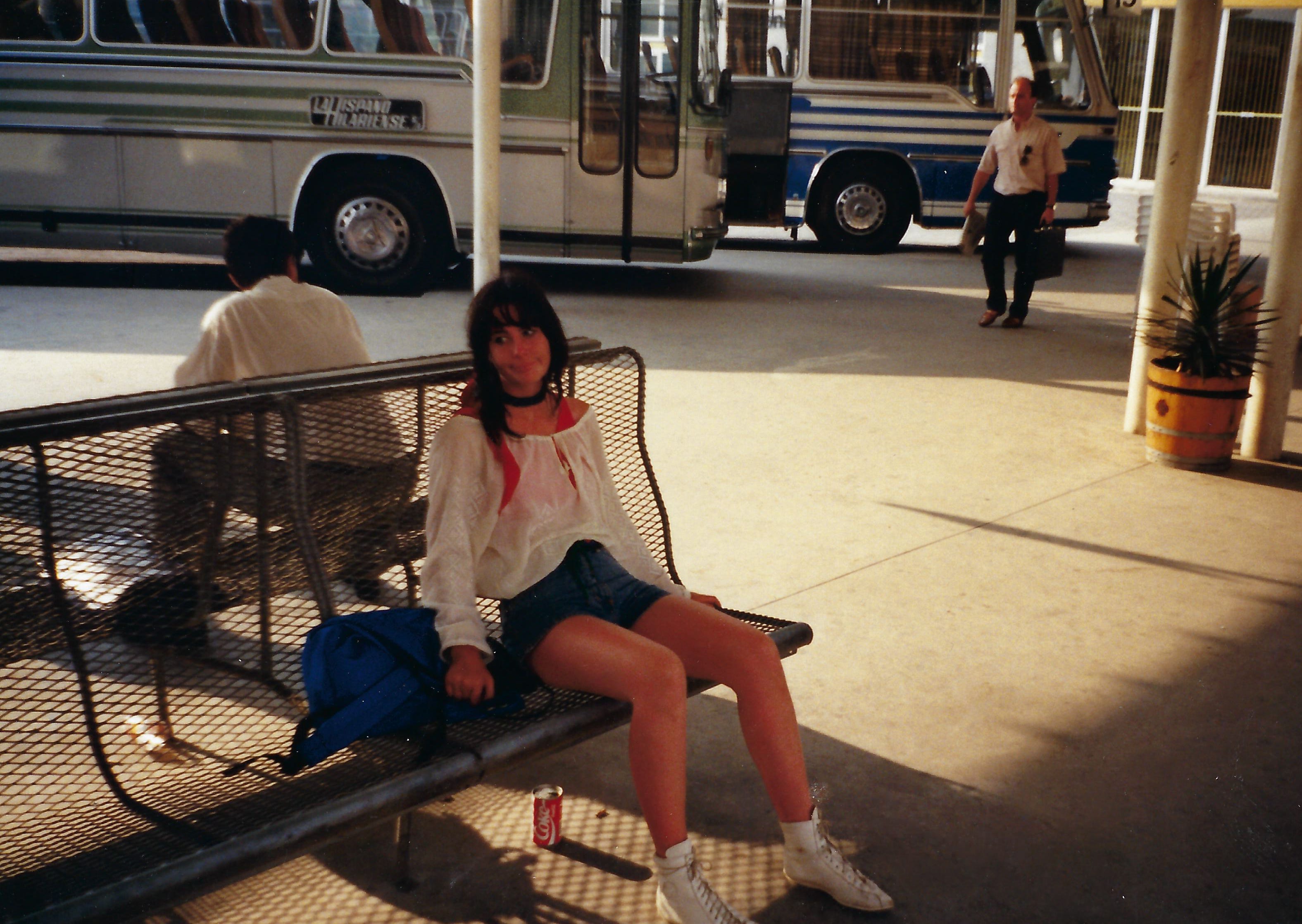
I also learned that ordering a café con leche worked considerably better when I remembered the con leche. I had never tried espresso before and was bemused by the tiny portion. “Más, más,” I exclaimed, to the confusion of the barista.
At dinner, Elsbeth tried to order a Black Russian. The waiter listened carefully, nodded, and replied, “Sí, White Russian.”
“No, Black Russian,” she said.
“Sí, White Russian.”
This went round a few times before we decided that somewhere between English, Spanish, and Catalan, black had become blanc, meaning white. What eventually arrived was certainly not what Elsbeth thought she had ordered. We had no idea what was in it, but it was delicious.
In the final days of the holiday, I bought something called sun oil. I had failed to appreciate the important distinction between oil designed to help you tan and sun cream designed to stop you burning. The oil offered no protection whatsoever and behaved rather more like cooking oil, and after a single afternoon frying in the sun, I tipped over into something approaching sunstroke.
I became a little delirious. At some point, for reasons that made sense only to me, I asked Elsbeth to tell me a story about Thomas the Tank Engine. Repeatedly. She still reminds me of it.
Then the holiday was over, and I returned to Liverpool, where Eldritch The Cat still had one game underway and one programmer in need of something to build.
Eldritch The Cat had Marc’s Astaroth to be getting on with, but I needed a project of my own, and the way you got a project in those days was to build a demo and then do the legwork to put it in front of publishers, as many as practicable. Of course, I built not one but two distinct demos, one building on tech I’d developed in previous games, and the other requiring a different kind of legwork: visiting the maths and physics sections of the Liverpool library and brushing up on my applied mathematics!
The first demo showed off smooth, multidirectional scrolling on the Atari ST, the kind of thing I had been chasing since the Spectrum days. I had figured out the multidirectional scrolling technique at Dentons while working on Gargantuan. I took no code with me when I left, only the know-how. At the time, scrolling freely in every direction was still unusual on the ST, and the demo looked suitably impressive.
The second demo was more functional and was written in ST BASIC, of all things, because the problem was mathematical rather than speed-critical: a handful of balls bouncing around inside a rectangle, colliding with the walls and with one another. This was the fruit of my Liverpool library endeavors and was a crude demonstration of the physics that would sit at the heart of the game.
I will spare you the workings underneath both. With the demos running and a one-page design brief in hand, long since lost, Marc and I had enough to start pitching the idea.
The game was called Scrollerball, which gives you a rough idea of how far the design had come. We knew we wanted a future-sports game, we knew it would have scrolling, and we knew it would have a ball. That was about the size of it.
The name came to us on a coach from London back to Liverpool. The driver had put on a VHS film for the journey, which that day happened to be Rollerball. Scrolling, a ball, Rollerball, Scrollerball. The name wrote itself, and it stuck as the working title, at least.
With us up north in Liverpool, and the publishers 250 miles away down south, in and around London, pitching meant a lot of travel. Our routine was to take a train or bus to London and then cram as many meetings into a single day as the timetable allowed. It was a repetitive process: run through the pitch, answer the questions to unenthusiastic ears, repeat.
The last meeting on one such day was with Electronic Arts and a producer named Kevin Shrapnell, out at Langley, near Heathrow Airport and Slough. Langley was another thirty minutes or so beyond central London, and by then, we were tired, and EA felt like a long shot. We came fairly close to skipping it.
We caught the train out to Langley anyway. To our surprise, Kevin turned out to be genuinely interested in poking at the idea rather than politely seeing us off the premises. More conversations followed, and not long afterward, Marc and I signed with EA to build the game, still under the working title Scrollerball, for the Atari ST and Commodore Amiga.
The deal was £17,000, paid in milestones over the course of development as an advance against royalties. It felt like a princely sum at the time. In reality, it was not a great deal of money on which to build two versions of a game.
Shortly afterward, a letter arrived from EA headquarters welcoming us to the fold. It was warm, decidedly American in tone, and greeted us as “Electronic Artists.” The first time I read it, I was genuinely confused. Wait, I thought, we’re not artists, we’re programmers. I got with the program soon enough.
I still have the contract. A few of its pages tell most of the story: an Electronic Arts Software Development and Publishing Agreement, dated December 1988, between EA’s British arm out at Langley and “Eldritch The Cat” at my house address in Croxteth Park. Note that the game is named “Scrollerball” on the first page, with the eventual name Projectyle scrawled in by hand beside it. The money is there too: £17,000 in all, released in stages across 1989, a thousand here and a couple of thousand there as each milestone was delivered and ticked off. And throughout, in EA’s own boilerplate, we are not the programmers we took ourselves for but the “Artist,” signed at the foot of the agreement by Steve Wetherill and Marc E.H. Dawson, as Marc then was.


The new company, with its new name, needed a logo, and Elsbeth came to the rescue, designing the bowing cat and the logotype that would grace each future Eldritch The Cat game. We also created letterhead paper and business cards featuring the same logo; for this, we approached none other than Gerry Fisher, award-winning creator of the Odin Computer Graphics cover art. Marc and I visited Gerry at his studio in the Woolton area of Liverpool, and we hammered out the layouts. We used a print shop on West Derby Road, near Newsham Park, for the actual printing.
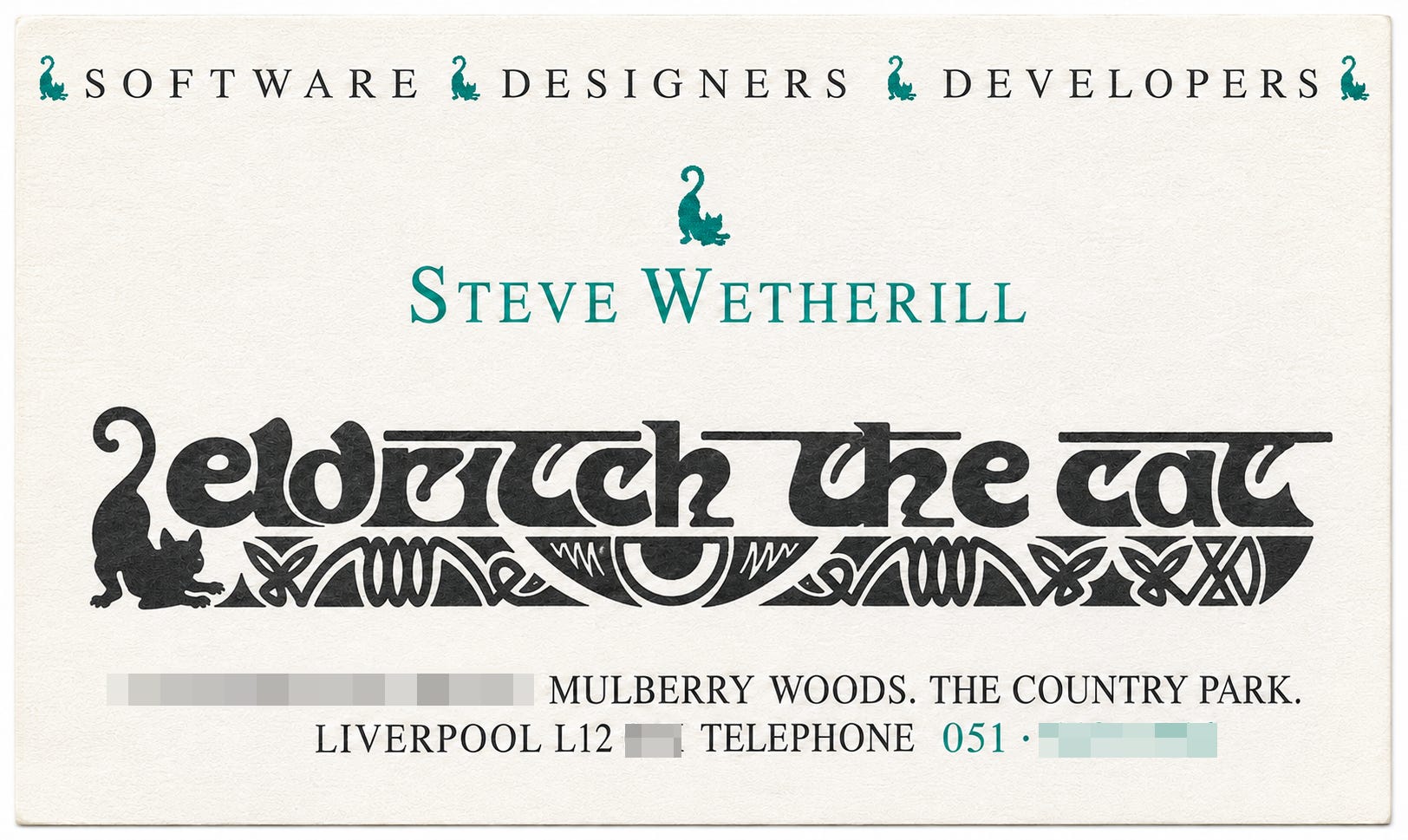
The business cards are quaint by today’s standards. No email address. No website. Just an address and a phone number.
It had been a brutal year: short of money to the point of desperation, working myself to death on three games at once, and then being fired. As 1988 came to a close, it was starting to feel like things might be turning a corner. I’d started my own company and our fledgling studio had a full slate of work: Astaroth signed with Hewson Consultants, and Projectyle signed with dream publisher Electronic Arts!
And Elsbeth, who’d spent a fortnight of that broke summer watching me sleep on her family’s sofa and, sunstruck, demand Thomas the Tank Engine stories, was somehow still around.
1989 was shaping up to be very interesting indeed!
This chapter is the thirteenth part of an ongoing series. An evolving list of chapters is available on the contents page.