
Chapter 11: Sometimes The Magic Works
The contract, the VIC-20, and the getaway car.

The end of Odin did not leave me with much beyond a finished game and an empty bank account. I had spent the dying months of the company running on fumes to get Sidewize out the door, and when the dust settled, I was, not to put too fine a point on it, skint. No savings, no cushion, and no great appetite for walking back into a full-time job with someone standing over my shoulder. Another thing I no longer had was housemates, and if you recall the very specific Faustian arrangement I’d entered into, this meant I was solely responsible for the mortgage payments, and in 1987, my interest rate was already over 10%, with worse to come.
What I did have was an idea for a follow-up to Sidewize, and just enough stubbornness to believe I could make a living from it. This would turn out to be both a useful quality and a costly one.
I did consider a few other options. Gary Bracey, Ocean’s head of development, pitched Colin and me on the film license for Platoon. It looked good on paper, but it was licensed work, subject to extremely strict deadlines that would have required Colin and me to work out of the Manchester office. I still didn’t drive, and with my public transport worldview, commuting there each day was not on the table. Colin didn’t want to move or commute either, so we passed on the Ocean option. Honestly, that was probably a mistake, but we were young and foolish and thought we could do better.
We visited Elite in Walsall, near Birmingham, and met with Steve Wilcox and some of his staff. They took one look at Sidewize and offered us a deal on the spot. The trouble was that they, too, wanted to do licensed titles, and licensed work came with schedules carved in stone. We passed, dodging a bullet. This time.
Closer to home, I recall Colin and me visiting Special FX in the Albert Dock (near the Granada TV offices) and meeting with Paul Finnigan and Joffa Smith. We showed them Sidewize, and there was some level of interest in doing something, but nothing came of it. I do recall Joffa looking at the smooth Sidewize scrolling and making a comment along the lines of, “I can see how you did that!” Joffa was the king of smooth scrolling on the Spectrum, so I took that as a nod of approval for my meager efforts.
Then there was Reptile Industries, run by John Robinson and Dave McGee, with an office near Castle Street in Liverpool city center. They would later reinvent themselves as Memory Expansion Systems, selling Amiga memory upgrades, but at the time, they were developing a Spectrum game called Anaconda and wanted Colin and me to take on a project for them. When I asked about a contract, the answer came back, “Sure, send us one.” This was not how I had imagined business worked. Surely the company offering the work was supposed to provide the contract? But I was young enough and green enough to wonder if perhaps I had missed something obvious. I had not. I never sent one because I had no idea what I was supposed to send, and I suspect they knew perfectly well I wouldn’t. The work never materialized. As far as I know, Anaconda never shipped either, though I think some code from the game was unearthed recently. Their memory business, on the other hand, thrived, and I would end up doing the odd job for them a few years down the line.
In the end, Colin and I threw in our lot with Tony Beckwith, a producer at Firebird. I had dealt with Tony in the last days of Odin, when he was the Firebird man assigned to keep an eye on us, and he was straightforward in a way that made the decision easy. I suspect Firebird saw a chance to claw back some of what they had sunk into Odin by keeping its refugees in the fold, though that is pure speculation.
Tony came up to Liverpool to see us, on his first visit to the city. He took the train from Euston into Lime Street, and I think he arrived half-expecting trouble. A city’s reputation tends to travel ahead of it, and Liverpool’s was worse than most. What did not settle his nerves was the greeting painted in enormous white letters on a wall as the train slowed into Lime Street:
COCKNEYS DIE!
To a Liverpudlian, Tony was a Cockney, however geographically accurate that actually was. He survived the experience, we signed on to make Crosswize, and a working relationship began.
We agreed to make the game for the princely sum of £10,000, which Colin and I would split evenly. With the benefit of hindsight, it was not a good deal, even in 1987 money. I knew what Firebird had been paying Odin per title under the old contract, and it was multiples of this, which makes it genuinely puzzling that we accepted so little. The honest answer, I think, is some combination of desperation and overconfidence: we needed the work, and we were certain we could turn it into something that led to better things.
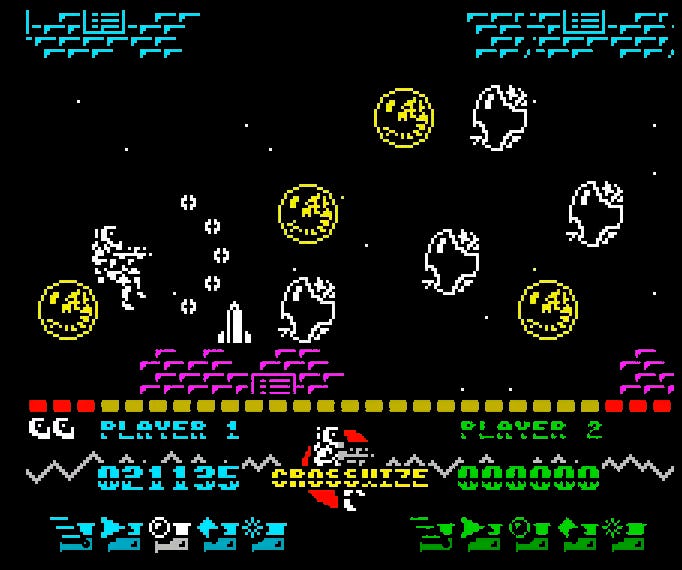
Crosswize was to be a sequel to Sidewize, and I knew exactly what I wanted to fix. Sidewize played well enough (extreme difficulty aside), but it was repetitive. One part was all black space; the other had the same handful of blocks sliding past again and again. I was convinced the Spectrum had more in it than that. The catch was that variety costs CPU time, and I could not have the elaborate, detailed backdrops I was picturing and still run the whole thing at fifty frames a second. So I made a trade. I dropped Crosswize to twenty-five frames a second, which still looked smooth on a television, and spent the time I bought on richer scenery. Rather than leave the backdrop as wallpaper, I folded it into the game itself. The scenery could hurt you if you flew into it, and certain enemies were tied to it, so the whole screen felt alive rather than painted on. On the third and final level, quite literally so: the entire scrolling background was animated!
The trade bought time in a very literal sense. At fifty frames a second, there had been almost none to spare. At twenty-five, I had one video frame, a fiftieth of a second, to run all the game logic, and a second frame to draw the screen, precalculating whatever I could during the first pass. Because the elaborate backdrop now repainted the whole playing area every frame, I could throw away the dirty-rectangle bookkeeping that Sidewize had needed to erase its sprites; this frame’s scenery simply buried last frame’s mess. The sprites still came off the stack, pushed onto the screen two bytes at a time, the way I had learned on Sidewize. But the trick I was proudest of was nearly invisible. As the player’s sprite drew itself over whatever was already on screen, the routine quietly accumulated any overlap in the Z80’s spare accumulator, its alternate A register, so that the instant the player sprite was fully drawn, I already knew, almost pixel for pixel, whether it had hit anything. Collision detection for very nearly free.
None of that came easily, and I would not want to leave the impression that it did. Every one of those tricks arrived only after days of getting it wrong: code that froze the machine solid, cycle counts I did by hand and still came up short on, a stalled screen I would stare at trying to work out which of my own clever ideas had turned on me. For weeks, it took everything I had. And here is the part I could not see at the time. None of it was going to earn me a penny more. The contract paid the same whether the scenery was alive or merely painted on, whether the collision was pixel-perfect or roughly right. I was pouring my best work into things a player would never consciously notice, because I could not bring myself to do it any other way, and, PUSH instruction by PUSH instruction, that idealism was gnawing away at the ship date I had agreed to. The labor was invisible. But sometimes that’s the magic trick. Right?
By late summer of 1987, the work was getting done, but the money was scarce. I was as broke as I had been the day Odin folded, and I had not taken a holiday in four years. I would not have used the word at the time, but I was fraying. I had gone flat out, with no real pause between finishing Sidewize and starting Crosswize, and the bill for that was quietly coming due.
Then, in September, two things happened.
The first, and by far the most important, was that I met the woman who would become my wife, Elsbeth Jones. “Met” is doing some heavy lifting in that sentence. One Friday night, Stoo and I were having what passed for a quiet drink in Milo’s, a rock bar on a lower level of Liverpool’s St John’s Centre, down a flight of stairs beneath the Beacon. Elsbeth and a friend decided it would be amusing to lob empty beer bottles at us. I was genuinely puzzled about where the projectiles were coming from, because, Milo’s being a rock bar, it was pitch black. Stoo ended up talking to Elsbeth’s friend, and I spoke to Elsbeth once or twice. “Oh, you make computer games,” she said. “I have a VIC-20.” That was about as far as the conversation went that night, and soon afterward, I left for a vacation in the States. Which was the second thing.
Earlier that year, I had taken a phone call from Stefan Walker, he of the upside-down Astro Charlie. Stef was ringing from his parents’ house in Nottingham, and he had news. “I’m moving to America with a new job!” He had secured a position with MicroProse in Hunt Valley, near Baltimore. He had passed his interviews with the UK arm of MicroProse, run by a fellow called Stewart Bell, and he was going west, young man. In the spring of 1987, Stef moved out to Baltimore to work on the Amstrad CPC version of Sid Meier’s Pirates! The logic of that escapes me to this day: rather than do the port to the UK-specific Amstrad in the UK, they flew someone across the Atlantic to do it. But Stef was off to the States, and that was that.
And they needed more programmers. So in September 1987, having somehow scraped together £300 for the plane ticket and with £200 of spending money in my pocket (which was, to be clear, everything I had to my name), I got on a plane in London and flew to Baltimore. My first time in the USA. A college friend, Ian, came along, and the plan was to crash on Stef’s sofa/floor/etc for two weeks of fun. On top of that, I was scheduled to meet the development people at MicroProse and talk about their open programming positions.
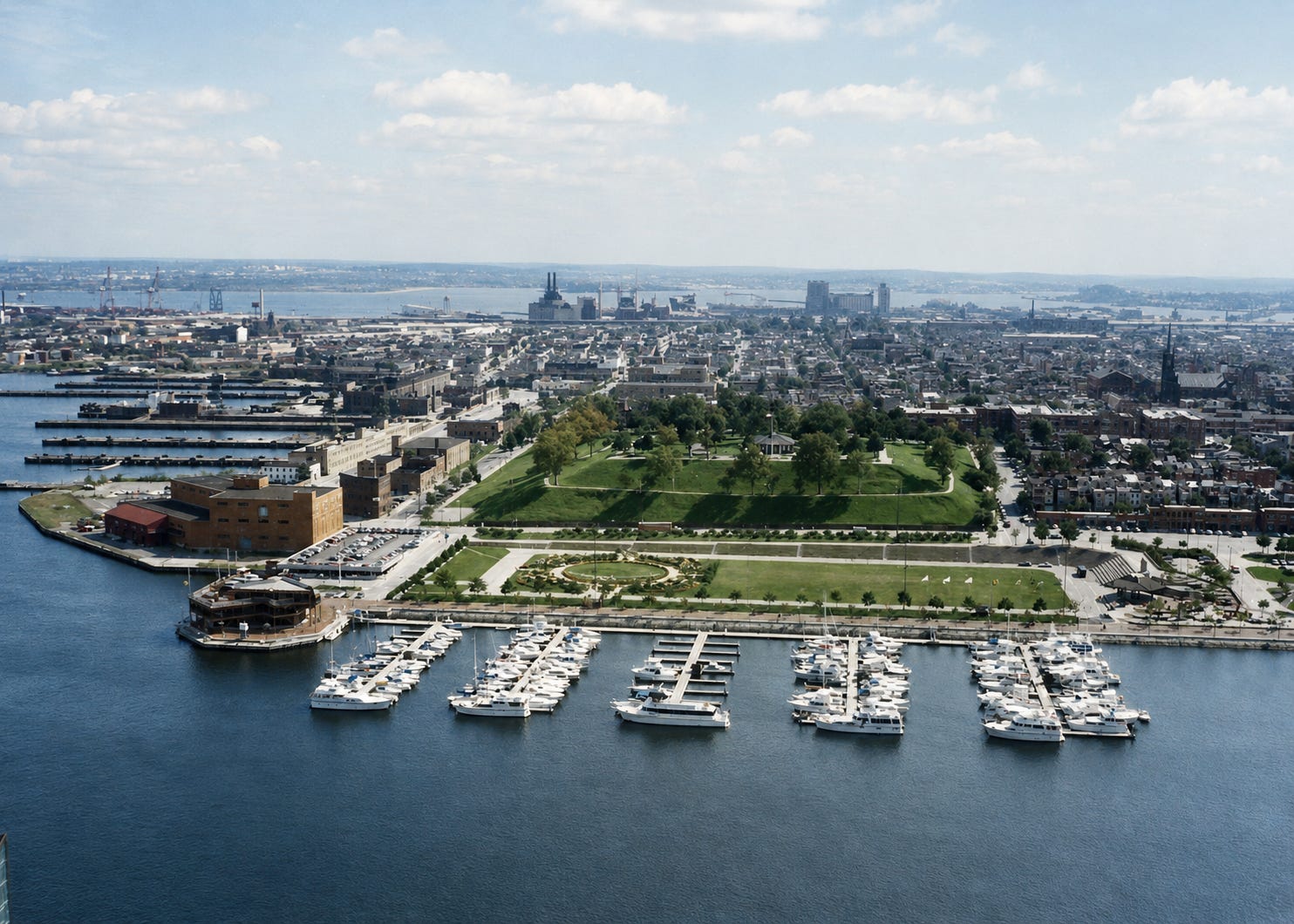
Baltimore was a lot of fun. Stef, Ian, and I made the most of a few of the local nightspots, all the while eking out my precious £200. Soon enough, my interview came around, and I turned up at the MicroProse office at the appointed time. Getting there was its own small adventure. We cadged a ride over to the Hunt Valley office from Stef’s place in Cockeysville, because we had no transport of our own and the bus service was patchy at best.
My first meeting was with Steve Meyer, then vice president of product development at MicroProse. That chat felt as though it went smoothly enough, and I was told that next I had to meet the newly hired development director, whose name (honestly) escapes me. I was looking forward to it, because it turned out he had recently moved over from the UK himself. His opening question was, “Have you heard of me?” A little taken aback, I answered carefully that I was aware of some of the games he had worked on. He proceeded to tell me how he had single-handedly done this, that, and all of the other, whereas I, he informed me, “had only worked as part of a team, so that is something to which we’ll have to give some serious thought.” I had not single-handedly done enough of the things, never mind all of them. By the time I left, I knew I did not have the job. It stung a little at the time. In retrospect, though, not getting the job was no great loss: I wasn’t ready to uproot my life and cross the Atlantic. Not yet.
I made the most of the rest of the trip. Ian and I took a Greyhound bus to Washington, DC, where we saw the White House, the Washington Monument, the Lincoln Memorial, and the Reflecting Pool (I am trying very hard to resist mentioning algae). On the way back, we took the wrong route to the Greyhound station, which in 1987 was a grim little place in a sketchy part of town. I remember walking through a genuinely rough neighborhood, convinced we were being followed.
Back in Baltimore, we went to Sid Meier’s bachelor party at his house. Yes, that Sid Meier. Everyone there was perfectly polite to me; by then, they had clearly decided not to move forward with my candidacy, though nobody had yet told me.
During the rest of our stay, we went to Hammerjacks, the rock club in downtown Baltimore, visited the waterfront, and frequented the Hunt Valley Mall. Reaching it meant a three-mile walk, the better part of an hour each way, in heat I remember as punishing. We startled a fair number of drivers just by being on foot; this part of America was not, on the whole, built for pedestrians. I even managed to go water skiing on Chesapeake Bay, though that experience mostly involved getting too far over my skis and ingesting copious amounts of the bay. Repeatedly.
Schaefers, a bar in the student town of Towson, was where America taught us a few things, and Ian came off worse in both lessons. The first night, last orders were called with his glass still full, so he tucked it inside his jacket to carry it out, not knowing that carrying an open container of alcohol on the street was illegal. A squad car sat outside the door. “Hey, you boy, what’s that under your jacket?” Ian, startled, produced the glass, and the officer swung his stick, smashing the glass on the sidewalk.
The second night was worse. The three of us got talking to a couple of girls, one of whom had a car and offered to drive us back the six miles to Cockeysville. What she did not mention was that one of them had a jealous boyfriend who was also at the bar. We pulled in at a bank for the ATM, and a car screeched in behind us. Two men got out, and Ian, in the back with his window down, took a sucker punch square to the jaw. Our driver floored it, threw the car through the drive-through ATM lanes until she lost them, and then came out with the memorable line: “I don’t often do this shit, but if I have to, I can.”
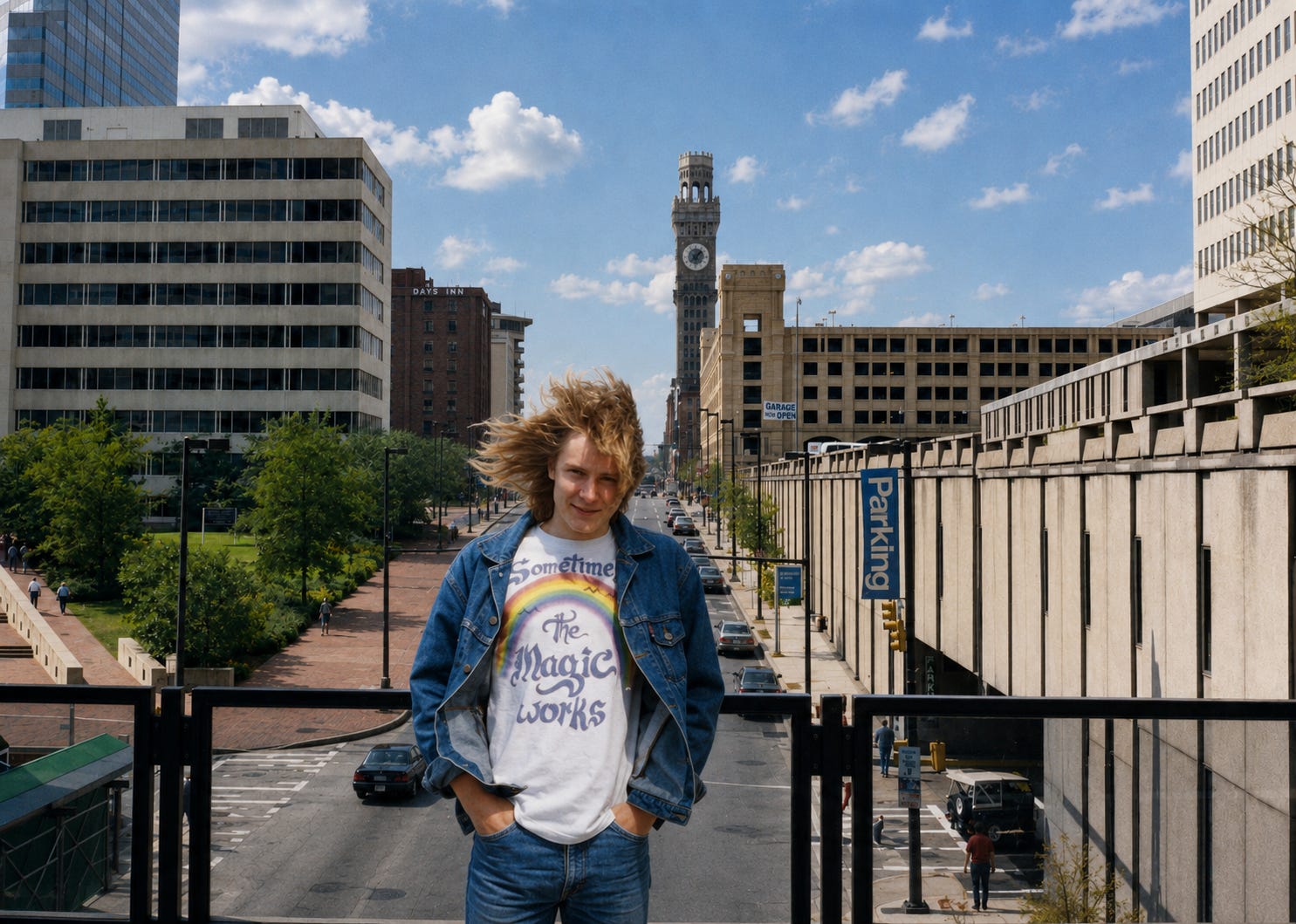
One afternoon, we caught a lift out to the Maryland Renaissance Festival, a famous, sprawling affair in the woods toward Annapolis, full of Americans in chain mail and bodices taking Olde England rather more seriously than any actual Englishman ever has. I crossed an ocean and ate fish and chips. The fish and chips were not bad, though if I recall correctly, the fish was served in a bun. I came home with a hand-painted T-shirt that read, “Sometimes The Magic Works.” Sometimes the trick is knowing when to stop. Something to think about on the way back to Liverpool. I wore that shirt until it fell apart.
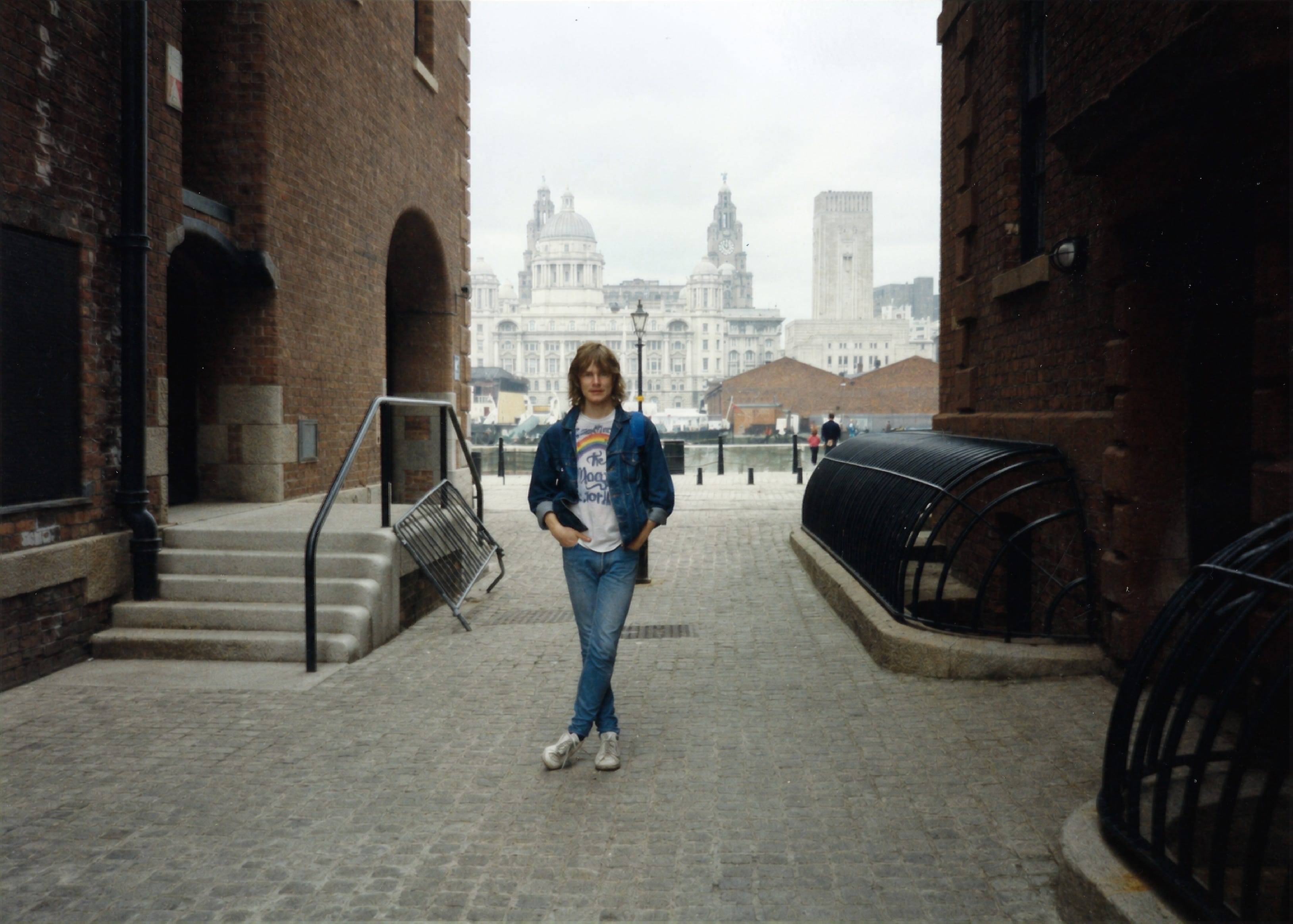
Being back in Liverpool felt like coming down to earth. My mind kept going back to America, the larger-than-life scale of everything, the endless possibilities. Liverpool, by contrast, felt suddenly small and boxed in. I have a distinct recollection of walking along Muirhead Avenue, carrier bags laden with shopping, picturing myself walking along an American street instead. I could do that, I thought to myself.
But Crosswize was waiting, and it wasn’t going to finish itself.
Things did not go smoothly for Stef at MicroProse. They dropped him gracelessly, it seemed to me, while he was back in the UK for Christmas that year. Stef was staying with me over the holiday break when that particular phone call came in. The Amstrad CPC version of Pirates! that he had built for them shipped to positive reviews all the same.
Meanwhile, development on Crosswize ground on. It was supposed to be finished by the end of 1987, but despite my best efforts, it was running late. It was really close, mind. I had also started looking around for whatever came next and begun talking to Denton Designs in Liverpool.
I thought Crosswize was nearly behind me. As it turned out, things were about to get very interesting.
This chapter is the eleventh part of an ongoing series. An evolving list of chapters is available on the contents page.
Loving reading these Steve! Great memories. Keep it up. All fascinating stuff!