

Preface: I’m using mostly American spellings mixed with some British terminology. If that does your head in, welcome to my world!
I’ve spent more than four decades making games, but this story starts much earlier, in a place and time where none of that was visible yet, and where the future looked very different from how it turned out.
I am a proud Yorkshireman, born in 1963 in Sheffield, an industrial city in England. Along the River Don, Sheffield's skyline was dominated for miles by massive red-brick steelworks and their smoke-belching chimneys. That industry made the city the engine of the North, and a primary target during the Blitz. It sounds grim, but only a short bus ride away, the Peak District countryside sat in stark contrast. Rugged moorland with jagged gritstone edges and sweeping views, balanced by rolling limestone hills, dry-stone walls, and quiet dales. Truly God's own country.
My parents, Kath and Tony, welcomed me into the world at Jessop Hospital for Women. We lived in a council terrace in Hillsborough, a short walk from the old Hillsborough Barracks. It was a dense, working neighborhood, built up long before the war, bordered by Langsett Road with its shops and bus stops, and threaded together by brick terraces and narrow side streets.
Just around the corner, my dad’s parents, Nanan Rose and Grandad Fred, lived in a red-brick terrace just off the main drag, the house where my dad grew up. It had a cold, damp cellar that always felt slightly menacing; an unlit outhouse toilet, a literal brick shithouse, with a freezing seat at night; and a shared cobbled yard with a gate leading to a small private garden and a swing.
Nanan Rose played the piano, and in later years, I was allowed to tinkle the ivories on the upright that held pride of place in the living room, picking out melodies from the pop songs du jour, “Yellow Submarine” by the Beatles being one.
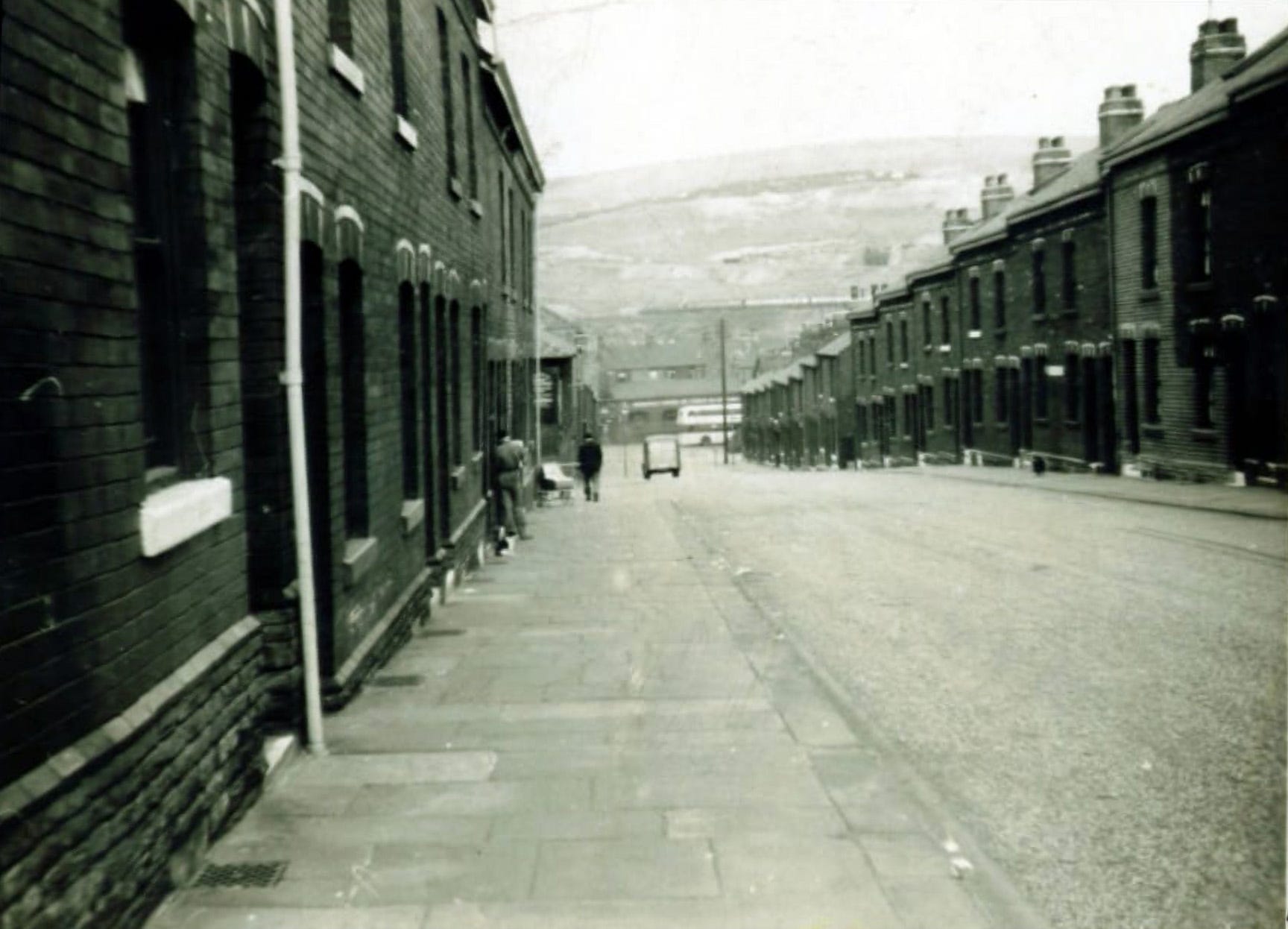
A narrow passage ran from the street through to the shared yard, just wide enough for bins, prams, and kids slipping through out of sight. In Sheffield, we called passages like that a gennel.
Our place sat in a quadrangle tucked behind the Langsett Road frontages, a typical layout for the time. We shared a cobbled yard with outside loos. My memories of the house itself are vague; I was just a wee nipper, but I remember the steep, narrow stairs, and my mum bathing me in a blue plastic tub on the kitchen counter next to the sink. It was a two-up, two-down. Simple, cramped, but home.
None of it survives now. Our house is gone. My grandparents’ terrace is gone. The gennels, yards, cellars, and outside toilets were swept away during the waves of urban renewal that rolled through the North in the 70s and 80s. Even some of the street names vanished with the buildings.
Hillsborough Barracks still stands, but only just, repurposed into retail and offices. Everything else exists only in old maps and memory.
Around 1965, we moved out to a new council development in Stannington, further west and higher up the hills, where the city begins to thin out into farmland and valley views. We lived in a so-called “maisonette” in a brand-new block up there. Maisonette might sound posh, but don’t be fooled. These were concrete-frame, two-story apartments stacked two high, built quickly during the housing boom with a focus on function over form. As a bonus, they did at least have indoor toilets. Our block had twelve maisonettes packed together across two stacked levels. No lifts, of course. If you lived on the upper level, you walked your pram or your shopping up and down several flights of stairs.
They’re still there today, though many are now privately owned. Thatcher’s Right to Buy at work. Some look tired; others have fresh paint. A few households have even fenced off the once-communal walkways, turning them into tiny front yards.
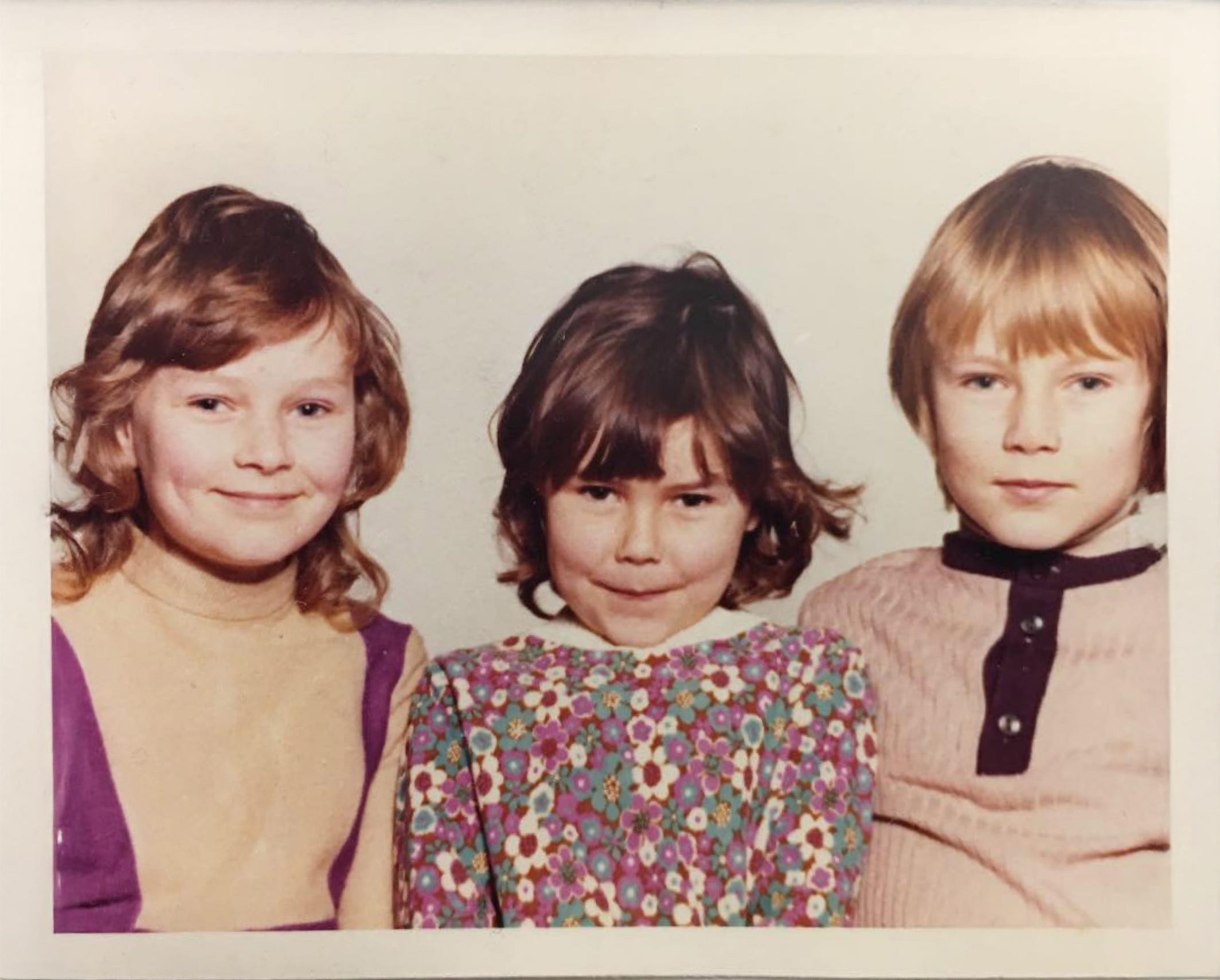
My sister Jane was born in 1965, and Lisa was born in 1967. We were a close-knit family. Though we didn’t have much, my parents’ work ethic meant we always had food on the table, shoes that fit, and a telly that more or less worked. My mum and dad did their best to give us a good start, and for that I will always be grateful. We were all we had, and we were enough.
Jane, who passed away in 2016, was kind, funny, and deeply loved. She was a good soul gone far too soon and is missed every day. Writing about these early years, it is impossible not to feel how much absence and presence shape memory in equal measure.
My dad is a musician, still performing until recently. Mostly self-taught, he got his start playing the piano in rough Sheffield pubs in the 1960s. By the late 60s and early 70s, he was playing keyboard in a local band called Jo’s Boys, and he spent years as half of a resident duo (performing under the stage name Tony Darren) at various working men’s clubs in the Sheffield area.
Being a local musician didn’t earn him much money, so for years he worked a full-time day job as well. He spent time working at Cranes music store in Sheffield, but the hardest shift was his stint as a door-to-door insurance salesman. It takes a specific kind of stamina to trudge up Sheffield’s seven steep hills, knocking on doors along those endless terraced streets to sell policies, only to head out to a smoky pub gig that same night.
Later, he stepped up to lead house bands for the “summer season” at Butlins holiday camps like Pwllheli in Wales, Ayr in Scotland, Bognor Regis, and the Metropole Hotel in Blackpool. A season meant being away for four or five months at a time, so he was often missing from home during my formative years. But the work was serious. He provided musical accompaniment for major acts on the circuit, including Freddie Starr, Ted Rogers, Bob Monkhouse, and Warren Mitchell.
I remember him telling us he’d once had to help push Freddie Starr’s Rolls Royce (or was it Ted Rogers’ Bentley?) outside the Metropole after a late show. I forget the details now. But that was the thing. My dad’s life away from us involved famous people and late nights and places we’d never see. And then he’d come home for a bit, and then he’d be gone again.
My mum also worked full-time. In my earliest memories, she spent several years as a postwoman. She would do her route on foot, rain or shine, taking an early bus to the main post office sorting facility to load her large mailbag with the day’s mail, and then catching another bus, dressed in her uniform and mailbag on her shoulder, to the Winn Gardens estate. There she went door to door, dealing with snapping dogs and the occasional unfriendly owner.
In 1968, I began my first year of school at Shooters Grove, situated between Stannington and Loxley on Wood Lane. The following year, I transferred to a new school called Roscoe Bank, which overlooked the Rivelin Valley. I still remember walking home from Shooters Grove up Wood Lane in my wellies through a foot of snow.
Roscoe Bank was a brand-new school when I arrived, but it didn’t last. It closed in 1992 and was eventually bulldozed, with nature reclaiming the site. I seem to recall reading that asbestos might have played a part, but I have never found anything official. Now it is just grass again, hard to pick out even on Google Maps. Shooters Grove, however, is still standing.
By the early 1970s, we relocated once more, this time to the Sutton Estate, a council housing development just outside Hillsborough’s center, near where the Wednesday ground sits. Our new place was one of the red-brick semis on the estate, built in 1927 under the will of William Sutton, a wealthy man who donated his fortune to provide decent housing for working-class families. These houses were sturdy, with a generous garden and only one adjoining neighbor, a significant upgrade in many ways. To my young mind, the place seemed almost new. I had no idea it was already nearly 50 years old.
The Sutton Estate was within walking distance of the rivers Don, Loxley, and Rivelin (if you were an energetic kid), three of the five main rivers running through Sheffield. Yes, it is the same Loxley where Robin Hood (Robin of the Wood...) was said to be from. The Don was filthy from industry, but Loxley and Rivelin were clean, having largely recovered from the era of water-powered mills. For my ninth birthday, my parents bought me a Vindec Speedster, a single-speed bike with 24-inch wheels. I rode it everywhere, especially along the Rivelin Valley, hanging out with friends by the river and its old millponds and the remains of waterwheels, relics of an earlier industrial age.
I went to Wisewood Primary and then Wisewood Secondary.
On one occasion at Wisewood Primary, the bell for lunch had just rung, and a small group of us shuffled towards our classroom for an extra-curricular session. As I stepped through the doorway, I cheerfully piped up, “Where’s Dobbo?” using the nickname all us kids had for our form teacher, Mr. Dobson. A hush fell over the room. From behind the tall desk at the front, a head rose. It was Mr. Dobson himself! The cheeky confidence I had felt moments before completely evaporated, and I felt my cheeks burn red. With a calm but firm voice that cut through the hush, he commanded, “Wetherill, out!” Funny how some things stick.
The primary school is still there, but the secondary school was torn down years ago, like so many others from that time. It is strange how many places from my childhood are gone now, buildings erased and communities scattered.
In 1975, we moved 15 miles north to Barnsley, which might as well have been a hundred. Sheffield and Barnsley were both Yorkshire towns, but they lived different lives. Barnsley was coal country, grimmer, harder, more insular.
The smell of burning coal got into your clothes, your nose, everything.
The move to Barnsley was preceded by an awkward incident. After I had said all my goodbyes and gone through the process of “leaving” Wisewood Secondary, it turned out our move was being delayed. So, yes, I had to return to the school I had just left and attend classes for a few more weeks. And then leave all over again. Pretty embarrassing for this 12-year-old.
We landed in Athersley South, a council estate on the edge of town built during the post-war housing boom of the 1940s. We moved into another red-brick semi that was practical, decent, and looked just like hundreds of others nearby. The house was heated with a coal fire, and the kitchen featured an old-style oven and stovetop unit, positioned directly behind and warmed by the same coal fire. The sheer amount of iron and steel in those things would likely make them impossibly expensive to manufacture today. Like most homes on the estate, we had an outhouse for storing coal, and the coal man would come once a week, delivering sacks to each house, hoisting them on his back, and tipping them into the coal shed.
I once managed to set the chimney alight in a somewhat reckless attempt to get the fire going. I had piled on too much coal, doused it with whatever was at hand, and gave it a bit too much encouragement. The flames caught, but so did the soot in the chimney. It was my fault, no question. I didn’t say much at the time, but I knew. We all knew. The house had a small garden and no real view, just the street, the neighbors, and a horizon punctuated by chimneys and, on a clear day, the Carlton slag heap.
With Dad away for such long stretches during those Butlins summer seasons, the weight of running the household had fallen squarely on my mum. It may come as no surprise to readers that the distance eventually took its toll. My parents separated in 1978 while I was in my mid-teens, leaving Mum to raise my sisters and me during our turbulent teenage years alone.
Mum was nothing short of heroic. She held down demanding full-time office jobs, first at the Yorkshire Traction bus company and later at the Star Paper mill, yet she would come home after a long shift and immediately start her second job, being a mum to a house full of teenagers. She cooked, she cleaned, and she kept on top of a mountain of laundry. Looking back, I honestly don’t know how she did it, and I am sure I wasn’t as much help as I ought to have been. But we survived. My mum, my sisters, and I battled on.
Around 1980, Dad found a way to combine his two worlds, the showman and the salesman. He landed a role on the sales team at Technics, just as electronic home organs were taking off in the UK. It was the perfect fit. The years of winning over tough crowds in clubs and charming homeowners on doorsteps had given him exactly the right skills. He'd drive from Slough to the far north of Scotland and everywhere in between, meeting dealers and performing at local venues to demonstrate the new instruments. He later moved on to Yamaha and Roland, always doing the same thing: playing the room and closing the deal.
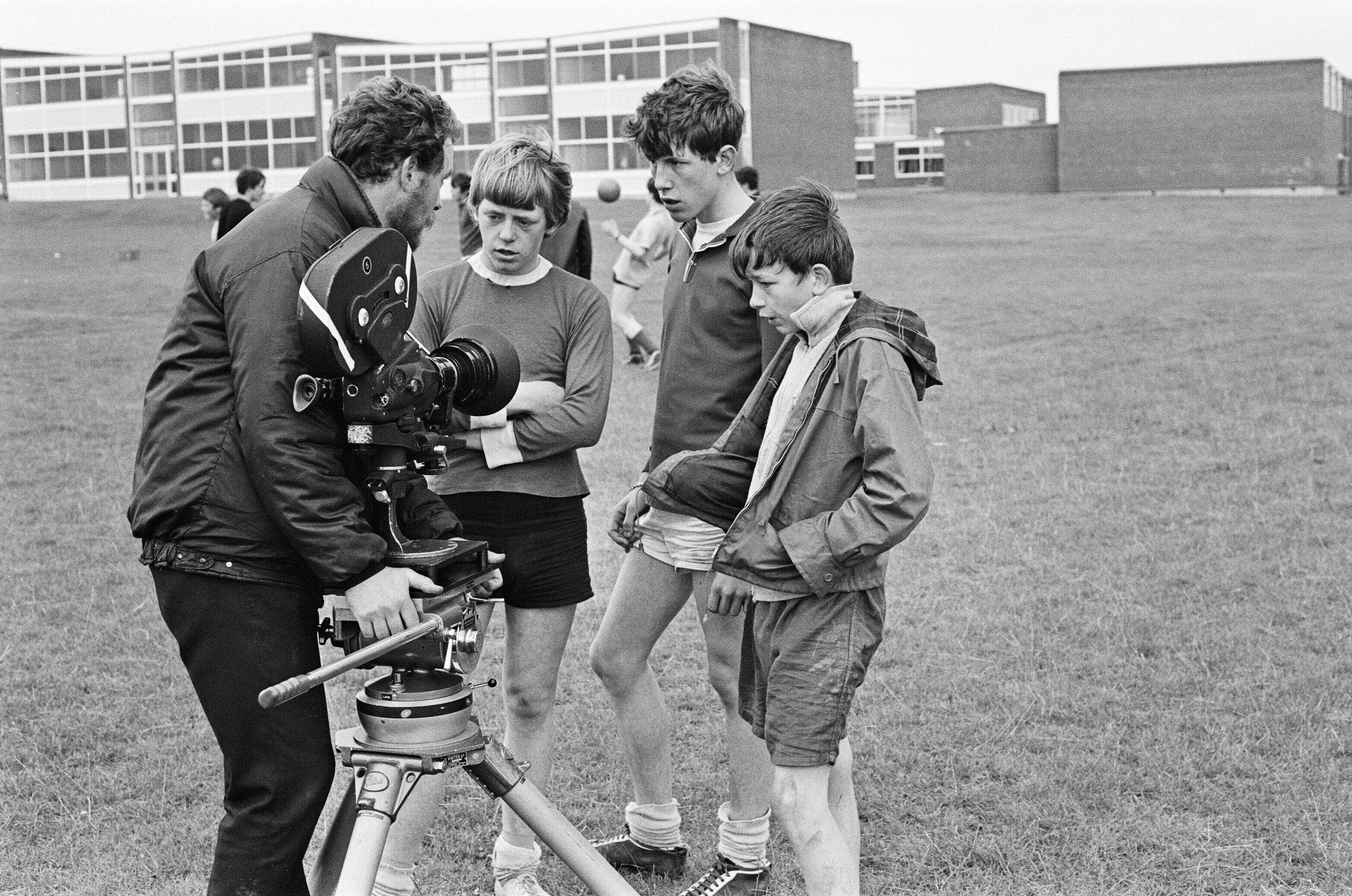
I attended St. Helen’s Comprehensive, a school known for its rough reputation and basic 1960s architecture: built quickly and cheaply, but not to last. A few years before my time there, the school had been used as one of the main filming locations for Kes, the film adaptation of Barry Hines’ novel A Kestrel for a Knave, directed by Ken Loach. You could still feel it. The film was right on the mark. No-nonsense teachers, gravel-voiced kids, and an air of low expectations. The accents, the attitude, the backdrop, they got that right. Everyone talked like Billy Casper: “I dun’t like school, but it dun’t mean to say I’ll like work. Still, I’ll get paid for not likin’ it.”
That about summed up the mood. The spirit of the place hadn’t changed much since they filmed. It was still a school where you kept your head down, watched your back, and hoped the teacher didn’t have it in for you.
To the uninitiated, the South Yorkshire dialect of the late 70s sounded like a collision between the industrial working class and the King James Bible. We used archaic forms like 'thee' and 'thou' unironically as standard pronouns. While the vocabulary was shared across the region, the delivery was not. In Sheffield, we hardened the sound into a flat, percussive d. Thee became dee, and thou became da. Barnsley kept the softer th, so to them it was thee and tha. Because I arrived with my hard Sheffield d, I was immediately pegged as an outsider. A dee dar.
It wasn’t just accents. The small words changed, too. What I had grown up calling a gennel was now a ginnel, or sometimes a snicket, depending on who you asked.
I remember one lad, Brian Dickinson, leaning over to me and saying, “Eyup, does tha lake football?” I thought he meant like it, so I replied, “Yeah, it’s OK.” But he pressed again, “Naw, does tha lake it?” That’s when I found out that ‘lake’ meant ‘play,’ possibly from Old Norse ‘leika.’ I had honestly never heard that expression in my life, coming from exotic and faraway Sheffield.
Despite the rough edges, I didn’t hate St. Helen’s. There were good teachers among the bad, and I found my way to the top sets in most subjects. I especially enjoyed maths with Mr. Ellison and physics with Mr. Whitney. Mr. Morton’s geography class wasn’t bad either.
I did get into trouble in chemistry class, though really through no fault of my own. Our chemistry teacher, Mr. Wright, would run extracurricular sessions for those interested, and so I found myself staying after school one afternoon to learn about Nitrogen Triiodide (or Ammonium Triiodide, as I’ve always known it).
Mr. Wright prepared a small amount of this substance, which, if you don’t already know, is an extremely unstable compound that will explode at the slightest touch. It is said that even a mosquito landing on some of it could be enough to set it off. Sure enough, the small amount Mr. Wright had prepared went bang when tapped with a pencil, and it was now our turn to make some.
It is simple to make. In the fume cupboard, we wet iodine crystals with ammonia on filter paper, let them dry, and presto: unstable NI₃. I was charged with removing the filter paper from the fume cupboard and placing it on a bench, which I duly, gingerly, did.
But then a sudden gust from a nearby window lifted the filter paper right out of the tongs I was using to move it, or maybe I was just clumsy. Regardless, the filter paper, with its explosive charge, floated, feather-like, out of my control and down, down, in slow motion, it seemed, toward the floor.
There was nothing anyone could do.
The filter paper landed with a BANG! and a plume of purple fumes. Thankfully, in the quantity we had made, there was more sound energy than physical detonation. Still, the explosion sent little bits of unexploded NI₃ all around the lab.
The reason I got in trouble was that during the days following this incident, the cleaning lady had come across some residue that BANGED! rather angrily, and repeatedly, at her, with purple fumes to boot, as she swept the chemistry lab floor. Someone had snitched, and I was summoned to Headmaster Bates’ (yes...) office to explain myself.
I walked out of Headmaster Bates’ office chastened but not deterred. I had learned that curiosity came with consequences, but also that it was something I wasn’t prepared to give up. The accidental purple explosions were not the end of it. They were just the beginning.
Chapter 2: The Locked Room

This is the part of the story where childhood ends, education begins to matter, and the gap between intention and reality starts to show.
This chapter is the first part of an ongoing series. An evolving list of chapters is available on the contents page.